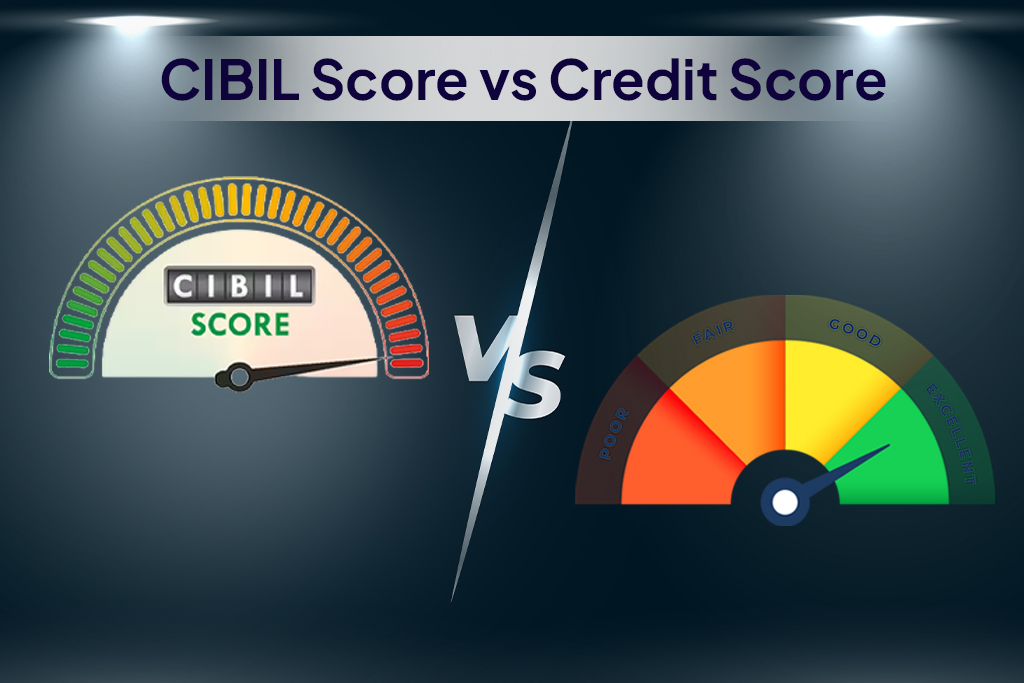
Most Indians use the terms CIBIL score and credit score interchangeably, but they are not the same thing. One is a category; the other is a specific product within it. This guide breaks down the CIBIL score vs credit score distinction clearly, so you know exactly what lenders see when they pull your report.
Quick Answer: A CIBIL score is a credit score issued specifically by TransUnion CIBIL. All CIBIL scores are credit scores, but not all credit scores are CIBIL scores, Experian, Equifax, and CRIF High Mark also issue credit scores in India with slightly different scoring models. CIBIL is a type of credit score, not a separate concept.
What is a Credit Score?
A credit score is a three-digit number that represents your creditworthiness, calculated by RBI-authorised credit bureaus based on your credit history. In India, four bureaus are licensed to issue credit scores: TransUnion CIBIL, Experian, Equifax, and CRIF High Mark. Each bureau uses its own proprietary algorithm, which means your score may vary slightly across them.
The score ranges from 300 to 900 for all bureaus. A score above 750 is generally considered strong by most banks and financial institutions. Lenders review your credit score, alongside income, existing liabilities, and repayment history, before approving personal loans, home loans, or credit cards. A higher score typically unlocks better interest rates, higher credit limits, and faster approvals. In short, your credit score is a summary of how reliably you’ve managed your credit accounts over time.
What is a CIBIL Score?
A CIBIL score is a type of credit score, one issued specifically by TransUnion CIBIL, formerly known as Credit Information Bureau India Limited (CIBIL). Established in 2000, it is India’s oldest and most widely referenced credit bureau. Like all bureau scores, the CIBIL score ranges from 300 to 900.
What sets the CIBIL score apart is its deep penetration among Indian banks. Most major banks and financial institutions, including SBI, HDFC, ICICI, and Axis Bank, pull the TransUnion CIBIL score as their primary benchmark during loan evaluation. So when someone tells you to “check your CIBIL score,” they mean the score from this specific bureau. The difference between credit and cibil score essentially comes down to the issuing bureau: CIBIL is the bureau; the credit score is the output. CIBIL is a type of credit score, not a separate concept from it.
CIBIL Report: Your Credit Report Card
While your CIBIL score is a single number, the CIBIL report is a detailed document that captures your complete credit history, think of it as your financial report card maintained by the Credit Information Bureau India.
What a CIBIL report contains:
- Personal Information: Your name, PAN, date of birth, address, and phone number as reported by lenders
- Credit Accounts: All active and closed loans, credit cards, and overdraft facilities linked to your PAN
- Payment History: A month-by-month record of your EMI payments, dues, and any defaults or write-offs the single biggest factor in your score
- Credit Enquiries: Every time a lender pulls your credit report for loan evaluation, a “hard enquiry” is logged here
- Credit Limit & Utilisation: Outstanding balances compared to your sanctioned credit limits across all accounts
Your CIBIL report is updated monthly based on data submitted by banks and financial institutions. Even a single error in your personal information or payment history can drag your score down unfairly. Reviewing your CIBIL report at least once every six months is a smart habit. If you spot a discrepancy, you can raise a dispute directly with TransUnion CIBIL for correction.
Maintaining a good payment record, paying EMIs on time, keeping credit utilisation below 30%, and avoiding multiple loan enquiries in a short period are the most effective ways to keep your CIBIL report healthy and your score climbing.
CIBIL Score vs Credit Score: Side-by-Side Comparison
Here’s a clear, head-to-head breakdown to help understand credit score vs CIBIL score, what’s the same, what’s different, and what matters when you apply for a loan.
| Parameter | CIBIL Score | Credit Score (General) |
| Issued By | TransUnion CIBIL (Credit Information Bureau India Limited) | Experian, Equifax, CRIF High Mark, or TransUnion CIBIL |
| Score Range | 300 to 900 | 300 to 900 (varies slightly by bureau) |
| Lender Preference | Preferred by most Indian banks (SBI, HDFC, ICICI, Axis) | Used by NBFCs, fintechs, and some banks |
| Update Frequency | Monthly, based on lender submissions | Monthly, based on lender submissions |
| Report Name | CIBIL Report | Credit Report |
| India-Specific? | Yes | Yes; all four bureaus are RBI-authorised and India-specific |
| Recognised by RBI? | Yes | Yes |
In practice, which bureau a lender checks matters more than the score label itself. Banks typically pull the TransUnion CIBIL score; NBFCs may cross-check Experian or CRIF scores as well. The key difference between a CIBIL score and a credit score, from a borrower’s perspective, lies not in what they measure, but in who issues the score and which lenders recognize or rely on it.
Credit Score and Loans in India
Most Indian banks pull the TransUnion CIBIL score when evaluating personal loans and home loans. NBFCs like FatakPay accept a 650+ CIBIL score for instant personal loans making credit accessible even if your score isn’t perfect. It is worth noticing the difference between credit score and CIBIL score; your Experian or CRIF score may differ from your CIBIL score, and some lenders check more than one. Maintaining a healthy repayment record across all bureaus is always the safer strategy.
Frequently Asked Questions
Is CIBIL score the only credit score that matters in India?
No. While the TransUnion CIBIL score is the most widely used, Experian, Equifax, and CRIF High Mark are also RBI-authorised bureaus whose scores are recognised by lenders, especially NBFCs and fintech lenders. Maintaining a strong score across all bureaus is the best approach.
Can my CIBIL score and Experian score be different?
Yes. Each bureau, TransUnion CIBIL vs Experian vs CRIF, uses its own algorithm and may receive slightly different data from lenders at different times. Your scores can vary by 10–30 points across bureaus, which is perfectly normal.
Are CIBIL scores and credit scores the same thing?
Not exactly. A CIBIL score is a specific type of credit score issued by TransUnion CIBIL. All CIBIL scores are credit scores, but credit scores can also come from Experian, Equifax, or CRIF High Mark. CIBIL is a subset of the broader credit score ecosystem in India.
How many times should you check your credit score?
Checking your own score (a “soft enquiry”) does not affect it. It’s good practice to check at least once every three to six months. Regular monitoring helps you catch errors early, track progress, and be loan-ready before you apply.
Which one is important, CIBIL or Credit Score?
Both are important, depending on your lender. Banks typically check your CIBIL score; NBFCs and fintechs may check scores from Experian or CRIF. Maintaining a strong credit profile across all bureaus ensures you’re prepared regardless of which score a particular lender pulls.
Does improving my CIBIL score improve all my credit scores?
Not automatically; each bureau calculates its score independently. However, the habits that improve your CIBIL score (timely EMI payments, low credit utilisation, avoiding frequent hard enquiries, and maintaining a healthy mix of credit accounts) will positively influence your scores across all bureaus over time.
Looking for a quick personal loan with a 650+ CIBIL score? FatakPay offers instant, flexible loans with minimal documentation, check your eligibility today.
| Instant Loans by Amount | |||
|---|---|---|---|
| ₹1500 Instant Loan | ₹2500 Instant Loan | ₹5000 Instant Loan | ₹10000 Instant Loan |
| ₹12500 Instant Loan | ₹15000 Instant Loan | ₹17500 Instant Loan | ₹20000 Instant Loan |
💡 Explore our latest Credit Score blogs for expert insights, financial tips, and guidance to help you make informed borrowing decisions..