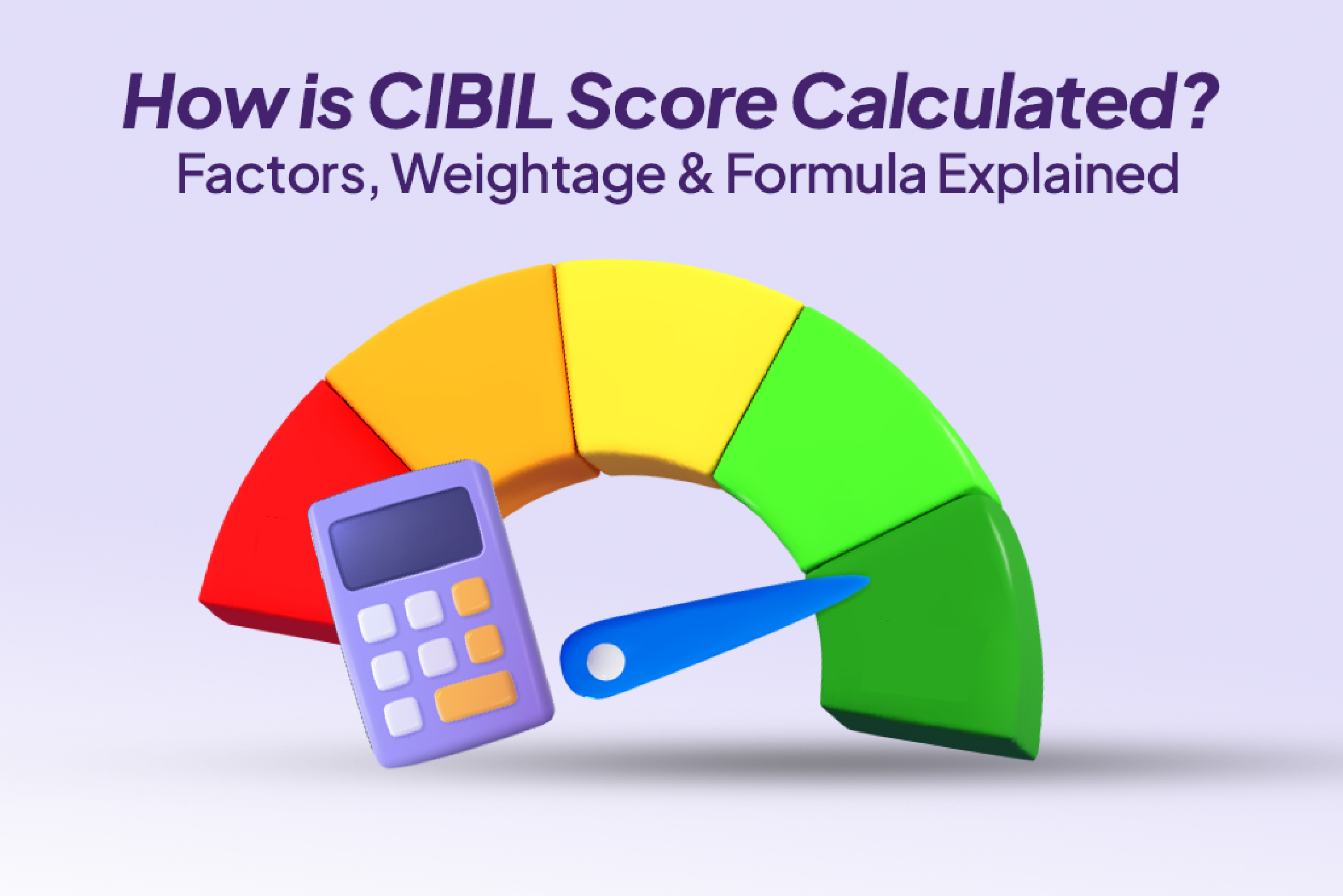
Your CIBIL score is not a random number, it is a precise, formula-driven output based on your credit behaviour. Knowing how is CIBIL score calculated gives you real power over your credit profile. Whether you’re planning a personal loan or just starting to build credit, this guide breaks it all down.
Quick Answer: Your CIBIL score is calculated based on four factors: payment history (30%), credit exposure/utilisation (25%), credit type and duration (25%), and other factors including recent inquiries (20%). Missing even one EMI can drop your score by 50–100 points within the next update cycle.
How is CIBIL Score Calculated?
CIBIL score calculation is carried out by TransUnion CIBIL using a proprietary algorithm that analyses data from your credit report, a document compiled from information submitted monthly by banks and financial institutions. Every loan account, credit card, repayment, default, and inquiry you’ve ever had is factored in.
The score ranges from 300 to 900. A score of 750 or above is considered strong by most lenders; below 650 signals higher risk. Understanding how is credit score calculated by TransUnion CIBIL helps you connect everyday financial decisions, paying an EMI on time, applying for a new card, to actual score movements.
The key inputs are your credit accounts (active and closed), your payment history, how much of your available credit you use, the types of credit you hold, and how recently you’ve applied for new credit. Together, these feed into a weighted model, with each factor carrying a defined percentage of influence over your final score.
As per RBI’s 2024 mandate, CIBIL updates credit data every 15 days, meaning improvements in your credit behaviour reflect faster than most borrowers expect.
4 Key Factors That Affect Your CIBIL Score
Here’s a clear weightage breakdown, the primary Featured Snippet trigger for this query:
| Factor | Weightage |
| Payment History | 30% |
| Credit Exposure / Utilisation | 25% |
| Credit Type & Duration | 25% |
| Other Factors (Inquiries, New Credit) | 20% |
Payment History – 30% Weightage
Payment history is the single biggest factor in how cibil score is calculated. It tracks whether you pay your EMIs, credit card bills, and loan instalments on time, every month, without exception.
Even one missed EMI can reduce your CIBIL score by 50–100 points in the very next update cycle. A record of consistent, timely payments signals to lenders that you are low-risk and dependable. Defaults, write-offs, or settlements, especially recent ones, cause the most severe damage to your credit profile and can take years to recover from. Maintaining a clean payment history across all your loan and credit card accounts is the fastest and most reliable way to improve your CIBIL score.
Credit Exposure / Utilisation – 25% Weightage
Credit utilisation measures how much of your total available credit limit you’re actually using. For example, if your combined credit card limit is ₹1,00,000 and your current outstanding balance is ₹40,000, your utilisation ratio is 40%.
A ratio below 30% is considered healthy by credit bureaus. High utilisation, using more than 50–60% of your limit regularly, signals credit dependency and can negatively impact your score. Keeping balances low relative to your credit limit, and requesting a limit increase if your spending has grown, are practical ways to manage this factor and build your credit score steadily.
Credit Type & Duration – 25% Weightage
This factor rewards a balanced, mature credit profile. It considers two things together: the mix of credit types you hold, and the age of your credit accounts.
A good credit mix includes both secured loans (home loans, auto loans) and unsecured credit (personal loans, credit cards). This demonstrates that lenders across categories have trusted you with credit. The length of credit history matters equally, older accounts add credibility to your profile. This is why it is always advisable to check your CIBIL score before closing a long-running credit card or old loan account; closing it can shorten your average credit age and reduce your score.
Other Factors (Inquiries, New Credit) – 20% Weightage
Every time you apply for a loan or credit card, the lender pulls your credit report, this is called a “hard inquiry.” Too many hard inquiries in a short window signal financial stress and can negatively impact your score by several points each.
This is why spacing out loan applications and avoiding multiple simultaneous applications across banks is critical to protecting your credit profile. New credit accounts also lower the average age of your credit history temporarily, which ties back to the previous factor. Being selective about new credit and only applying when genuinely needed, protects both this category and your overall score.
What Actions Hurt Your CIBIL Score the Most?
Understanding how credit score is calculated also means knowing what damages it fastest:
- Missing EMI payments: even one missed EMI drops your score 50–100 points
- Maxing out credit cards: utilisation above 50% signals credit stress to bureaus
- Multiple loan applications in quick succession: triggers hard inquiries that accumulate
- Settling a loan for less than the full amount: marks your account as “Settled,” which lenders view negatively
- Closing your oldest credit account: shortens your credit history and lowers your score
- Guaranteeing a loan for someone who defaults: their default affects your credit report too
Conclusion
How is CIBIL score calculated comes down to four weighted factors, payment discipline, credit utilisation, credit mix and age, and inquiry behaviour. Knowing the formula puts you in control. Even with a score of 650, FatakPay (RBI-registered | FACE member | ISO 27001 certified) approves instant personal loans in 7 minutes, no salary slip, no branch visit. Building better credit habits today means better loan terms tomorrow.
FAQs
How Long Does It Take for CIBIL Score to Update?
As per the RBI 2024 mandate, TransUnion CIBIL updates credit data every 15 days based on information submitted by banks and financial institutions. So if you pay off a large outstanding balance or clear an overdue EMI, you could see your score improve within two to four weeks, faster than most borrowers expect.
Can a High Credit Limit Improve My CIBIL Score?
Yes, indirectly. A higher credit limit reduces your credit utilisation ratio, assuming your spending stays the same. For example, if your outstanding is ₹20,000 and your limit goes from ₹50,000 to ₹1,00,000, your utilisation drops from 40% to 20%, which positively impacts your CIBIL score calculation. You can request a limit increase from your bank without triggering a hard inquiry in many cases.
How Does a Missed EMI Payment Affect My CIBIL Score?
A single missed EMI can drop your CIBIL score by 50–100 points within the next update cycle. The impact is greater if your score was already strong, lenders report overdue payments to credit bureaus as soon as 30 days past the due date. Consecutive missed payments cause cumulative damage that can take 12–24 months of consistent repayments to recover from.
Does Closing an Old Loan Account Affect My Score?
Yes, it can. Closing an old loan account reduces the average length of your credit history, which carries 25% weightage in CIBIL score calculation. If the closed account was your oldest credit account, the impact is more significant. On the other hand, if the account had a poor repayment record, closing it may be strategically wise. Always check your CIBIL report before deciding.
How Much Does Credit Utilisation Ratio Impact CIBIL Score?
Credit utilisation carries 25% weightage in how is CIBIL score calculated. Keeping your utilisation below 30% is considered ideal. Exceeding 50% regularly can negatively impact your score significantly. For example, on a ₹1,00,000 limit, keeping your outstanding balance under ₹30,000 keeps you in the safe zone. If you frequently hit higher utilisation, consider requesting a credit limit increase from your bank.
Can a New Credit Card Application Lower My CIBIL Score?
Yes, temporarily. Every credit card application triggers a hard inquiry on your credit report, which can lower your score by 5–10 points per inquiry. Applying for multiple cards within a short period multiplies this effect. Additionally, a new card lowers the average age of your credit accounts. Space out applications and only apply for new credit when genuinely required to protect your credit profile.
Score 650 or above? FatakPay approves instant personal loans in 7 minutes, no salary slip, no branch visit. Check your eligibility today.
| Instant Loans by Amount | |||
|---|---|---|---|
| ₹1500 Instant Loan | ₹2500 Instant Loan | ₹5000 Instant Loan | ₹10000 Instant Loan |
| ₹12500 Instant Loan | ₹15000 Instant Loan | ₹17500 Instant Loan | ₹20000 Instant Loan |
Explore our latest Credit Score blogs for expert insights, financial tips, and guidance to help you make informed borrowing decisions.