Your CIBIL score doesn’t move randomly, every change traces back to a specific behaviour or event in your credit history. Knowing the factors affecting your credit score puts you in control. FatakPay (RBI-registered | FACE member | ISO 27001 certified) breaks down exactly what affects CIBIL score and by how much.
Quick Answer: Factors affecting CIBIL score: Four key factors – payment history (30%), credit utilisation (25%), credit mix and duration (25%), and hard inquiries from new loan or card applications (20%). Payment history and utilisation together make up 55% of your score.
What Is a Credit Score?
A credit score is a 3-digit number between 300 and 900, calculated by RBI-licensed credit bureaus like TransUnion CIBIL based on your borrowing and repayment behaviour. It is the primary metric lenders use to evaluate loan approvals, set interest rates, and determine credit limits. A score of 750+ is considered strong. To learn more, read our detailed guide on what is a CIBIL score.
What Affects CIBIL Score?
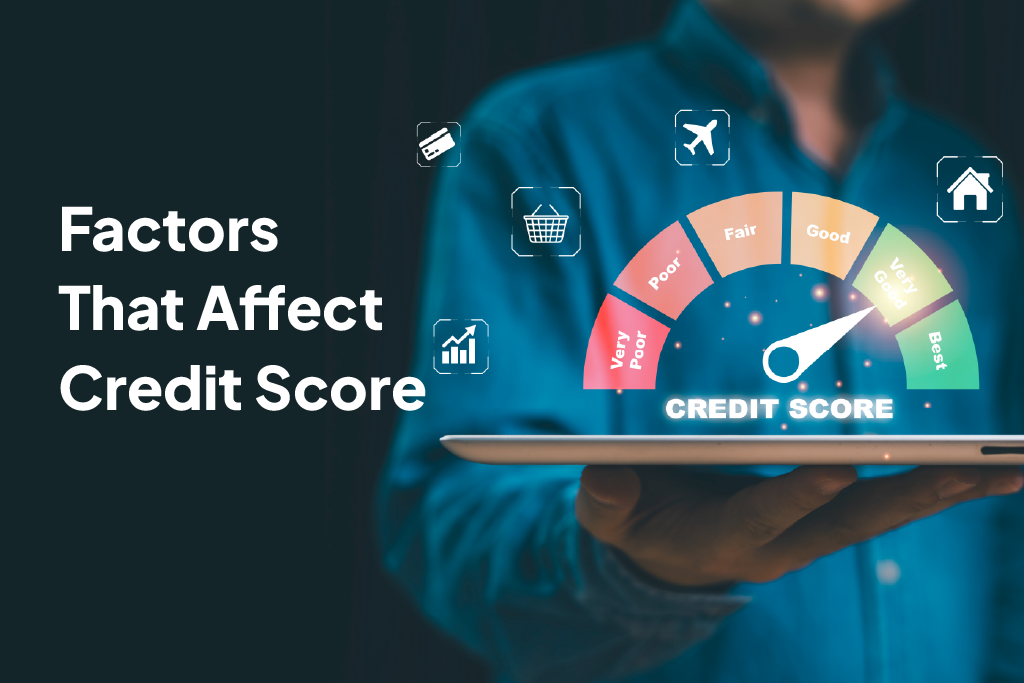
Here’s a clear weightage breakdown, the top factors affecting your CIBIL score, ranked by impact:
| Factor | Weightage | Key Variable |
| Payment History | 30% | On-time vs missed EMI/card payments |
| Credit Utilisation | 25% | Outstanding balance vs total credit limit |
| Credit Mix & Duration | 25% | Types of credit + length of credit history |
| Hard Inquiries / New Credit | 20% | Loan and credit card applications |
Payment History – 30% Weightage
This is the single biggest factor in what affects your credit score, miss even one EMI and your score drops by 50-100 points. Payment history tracks whether you pay all your loan EMIs, credit card bills, and other credit obligations on time, every month. A single default, write-off, or settlement leaves a mark on your credit report that can take years to recover from.
Consistently paying on time, across all credit accounts, is the fastest and most reliable way to build a high CIBIL score. Auto-pay mandates eliminate human error from the equation entirely.
Credit Utilisation – 25% Weightage
Credit utilisation is the ratio of your outstanding credit balance to your total available credit limit, keeping it below 30% is critical. For example, if your combined credit card limit is ₹1,00,000, you should carry no more than ₹30,000 in outstanding balance at any time. Exceeding 50% signals credit dependency and negatively impacts your score significantly.
If you regularly hit high utilisation, request a credit limit increase from your bank, this immediately improves your ratio without reducing spending. Keep credit utilisation below 30%, if you need emergency funds, a FatakPay instant personal loan is a better option than maxing out your credit card.
Credit Mix & Duration – 25% Weightage
A longer credit history and a diverse mix of credit types, secured (home loans, auto loans) and unsecured (personal loans, credit cards), strengthens your CIBIL score. Credit bureaus reward borrowers who have demonstrated they can manage different types of credit responsibly over time.
This is why closing your oldest credit account is almost always a bad idea, it shortens your average credit age and reduces your score, even if the account had a clean record. If you only hold unsecured loan products, adding a secured loan (or vice versa) improves your credit mix and this factor’s contribution to your score.
Hard Inquiries & New Credit – 20% Weightage
Every time a lender pulls your credit report in response to a loan or credit card application, a hard inquiry is logged, and each one temporarily reduces your score by 5-10 points. This is what impacts your credit score when you shop around for loans without a strategy.
Applying to multiple lenders simultaneously creates multiple hard inquiries within a short window, compounding the impact. Space applications at least 3-6 months apart, and use soft-inquiry eligibility checks before submitting full applications.
What Does NOT Affect Your CIBIL Score
One of the most persistent misconceptions about what impacts your CIBIL score is that salary and employment status are direct inputs. They are not. Income and employment status do not directly affect your CIBIL score, only credit behaviour matters. Your score is based entirely on how you manage credit, not how much you earn. A high-income borrower who misses EMIs will have a lower score than a moderate-income borrower who pays every dues on time.
Conclusion
The factors affecting your CIBIL score are all within your control, they are behaviours, not circumstances. Payment discipline and credit utilisation management together account for 55% of your score. Understanding the top factors affecting credit score is the first step; acting consistently on each one helps you build your credit score and create the credit profile that unlocks better loan terms, lower interest rates, and faster approvals.
Check your CIBIL score free on FatakPay, and if your score is 650+, apply for an instant personal loan disbursed in 7 minutes, no salary slip required.
| Personal Loans by City | ||||
|---|---|---|---|---|
| Personal Loan Bengaluru | Personal Loan Thane | Personal Loan Mumbai | Personal Loan Hyderabad | |
| Personal Loan Pune | Personal Loan Surat | Personal Loan Coimbatore | Personal Loan Delhi | |
| Personal Loans by Amount | ₹60,000 Personal Loan | ₹3 Lakh Personal Loan | ₹5 Lakh Personal Loan |
|---|
💡 Explore our latest Credit Score blogs for expert insights, financial tips, and guidance to help you make informed borrowing decisions..