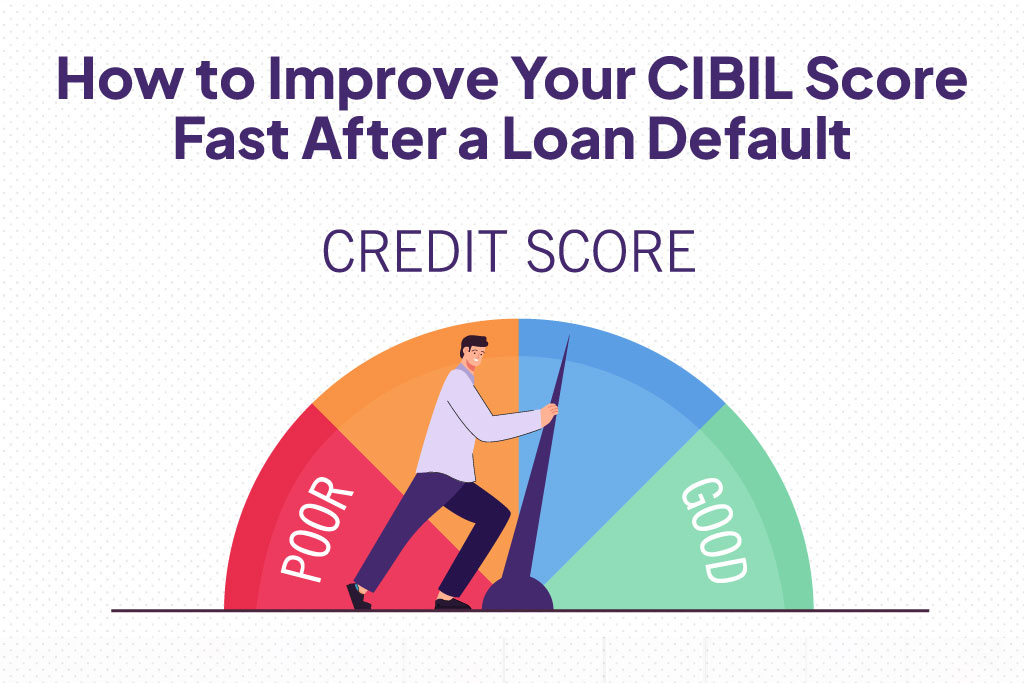
A loan default can cause significant damage to your credit profile and make future borrowing difficult. The good news is that credit scores can recover with the right actions and consistent financial discipline. Understanding the recovery process and taking corrective measures quickly can help you rebuild your CIBIL score and regain lender confidence.
Many borrowers assume that a default permanently ruins their creditworthiness, but this is not the case. Credit bureaus continuously update records based on your latest repayment behavior, which means positive financial habits can gradually outweigh past mistakes. By staying proactive, monitoring your credit report regularly, and maintaining timely payments, you can steadily improve your credit profile over time.
What Happens to Your CIBIL Score After a Loan Default?
A loan default can immediately reduce a healthy CIBIL score of 750+ by approximately 100–150 points, often bringing it below 600. Once a borrower misses payments for more than 90 days, the account may be classified as a Non-Performing Asset (NPA) by the lender. The account status in the credit report typically progresses from “Overdue” to “NPA” and eventually to “Settled” or “Written Off.” One important distinction is that “Settled” does not mean “Closed.” Lenders generally view a closed account more favourably than a settled account because settlement indicates that the borrower paid less than the full outstanding amount.
A default CIBIL score situation can significantly reduce your borrowing options, but timely corrective actions can help improve your credit profile over time.
In addition to lowering your score, a loan default can affect your ability to obtain new credit cards, personal loans, home loans, or even favourable interest rates. Many lenders review recent repayment behaviour before approving applications, so a default may lead to stricter eligibility checks. However, as you begin making timely payments and demonstrate responsible credit usage, the negative impact of the default gradually decreases over time.
The 3 Stages of Loan Default Recovery
Stage 1: Default Just Happened (0–3 Months) — Act NOW
The sooner you act, the better your chances of minimizing long-term damage. Contact the lender immediately, explain your financial situation, and explore options such as restructuring, payment deferrals, or revised repayment plans. Acting early may help prevent the account from being classified as an NPA.
Stage 2: Account Declared NPA (3–12 Months) — Negotiate
If the account has already become an NPA, engage with the lender and negotiate a repayment solution. Where possible, pursue a Full & Final settlement or repayment arrangement. After payment, obtain a written No Objection Certificate (NOC) and request the lender to update the account status correctly. A “Closed” status is generally more favorable than a “Settled” status.
Stage 3: Account Written Off (12+ Months) — Rebuild
Even if the lender has written off the account, repayment and settlement can still help improve your credit profile. Obtain an NOC after settlement and verify that the lender updates the credit bureau records. If the report is not updated correctly, raise a dispute with the credit bureau for correction.
Borrowers looking to rebuild credit score after loan default should focus on creating a consistent record of on-time payments and low credit utilization.
6 Proven Steps to Rebuild CIBIL Score After Default
Many borrowers wonder how can I improve my CIBIL score after default, and the answer usually involves clearing dues, correcting report errors, and maintaining a strong repayment record.
Step 1: Settle the Defaulted Account
Clear the outstanding dues and obtain an NOC from the lender. Request an update to reflect the account as “Closed” wherever possible.
Step 2: Check All Four Credit Bureau Reports
Review reports from CIBIL, Experian, Equifax, and CRIF to ensure the information is accurate and understand how to correct your CIBIL report if any errors or outdated records are identified. Errors or outdated records can delay recovery.
Step 3: Get a Secured Credit Card
A secured credit card backed by a fixed deposit of around ₹10,000 can help you start rebuilding your credit history immediately and is often one of the most effective ways to learn how to build credit score from scratch after a default. Use it responsibly and pay dues on time.
Step 4: Take a Small Credit Product and Repay Perfectly
A small loan from a regulated lender, fintech, or NBFC can help demonstrate positive repayment behaviour. Focus on making every EMI on time.
Step 5: Keep Credit Utilization Below 30%
Maintain a low Credit Utilization Ratio (CUR) on credit cards. Lower utilization signals responsible credit management and supports score improvement.
Step 6: Set Up NACH Auto-Debit
Automating repayments reduces the risk of missed EMIs. Maintaining a flawless payment record for at least 12 months is critical for recovery.
If you are searching for how to improve CIBIL score after default, consistency in repayments and responsible credit usage are often the most important factors in long-term recovery.
CIBIL Score Recovery Timeline After Default
| Action Taken | Timeline to Score Improvement |
| Settle account + obtain NOC | 45–60 days for bureau update |
| Secured credit card + 6 months of clean usage | Potential improvement of 50-80 points |
| 12 months of on-time repayments | Potential improvement of 100-150 points |
| 18-24 months of disciplined credit behaviour | 700+ score may become achievable if no new defaults occur |
While results vary by borrower profile, consistent positive behaviour is usually rewarded over time. Understanding how to recover CIBIL score after default requires patience, as meaningful improvement usually happens through months of disciplined financial behaviour.
Conclusion
Recovering from a loan default takes time, but it is possible with consistent effort. Clearing outstanding dues, correcting credit records, maintaining timely repayments, and using credit responsibly can gradually rebuild your CIBIL score. One of the most effective answers to how to improve credit score after loan default is to establish new positive credit behaviour that gradually outweighs older negative records. The key is to focus on long-term financial discipline and avoid repeating past credit mistakes. Once your credit profile improves, you may be able to apply for personal loan after credit recovery with better approval prospects and loan terms.
Rebuilding credit score after loan default is a gradual process, but borrowers who maintain financial discipline often see steady improvement in their credit profile over time.
FAQs on Improving CIBIL After Loan Default
How long does a loan default stay on CIBIL report?
A loan default may remain visible on your credit report for several years, although its impact gradually reduces as positive credit history builds.
Can I improve my CIBIL score after a loan settlement?
Yes. Even after a settlement, you can improve your score by maintaining timely repayments, reducing debt, and building a positive credit history.
What is the difference between settled and closed in CIBIL?
A “Closed” account indicates the loan was fully repaid, while a “Settled” account means the lender accepted less than the full outstanding amount. Lenders generally prefer closed accounts.
How fast can I rebuild my CIBIL score after default?
Some improvement may be visible within a few months, but meaningful recovery often takes 12–24 months of disciplined credit behavior.
Will banks give me a loan after I have defaulted?
Yes, but approval may be more difficult initially. As your credit score improves and your repayment history strengthens, your chances of obtaining future credit increase.
| Instant Loans by Amount | |||
|---|---|---|---|
| ₹1500 Instant Loan | ₹2500 Instant Loan | ₹5000 Instant Loan | ₹10000 Instant Loan |
| ₹12500 Instant Loan | ₹15000 Instant Loan | ₹17500 Instant Loan | ₹20000 Instant Loan |
Explore our latest Credit Score blogs for expert insights, financial tips, and guidance to help you make informed borrowing decisions.