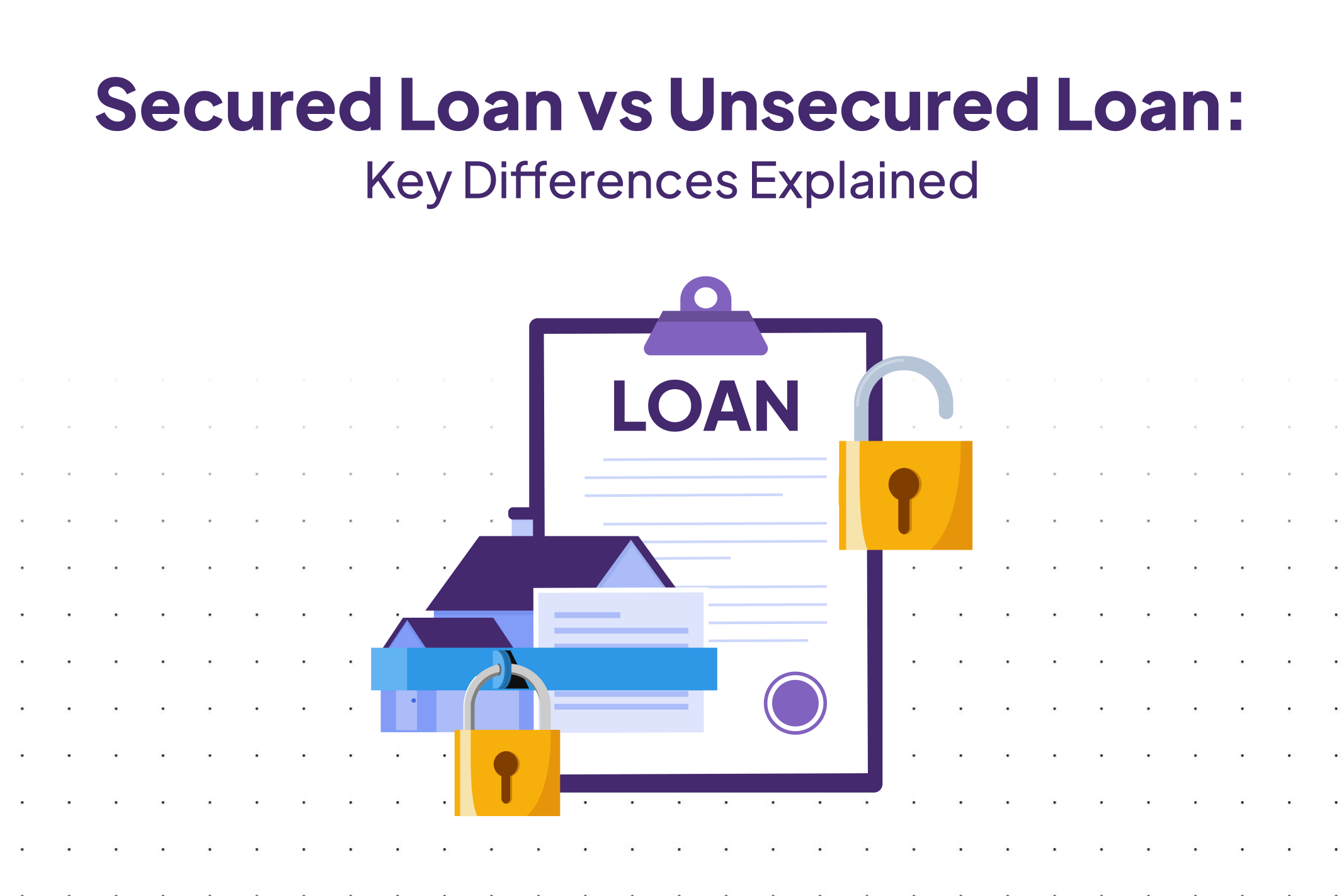
When borrowing money, one of the most important decisions is choosing between a secured loan and an unsecured loan. Both options provide access to funds, but they differ in terms of collateral requirements, interest rates, eligibility, and risk. Understanding the difference between secured loan and unsecured loan can help borrowers choose a financing option that matches their borrowing needs and risk tolerance. Understanding the difference between secured and unsecured loans can help you select the right financing option based on your needs and financial profile.
Before applying for any loan, it is important to assess your financial goals, repayment capacity, and overall borrowing costs. Evaluating factors such as monthly installments, loan tenure, processing fees, and potential risks can help you make a more informed decision and avoid financial strain in the future.
What Is a Secured Loan?
A secured loan is a type of loan backed by collateral such as property, gold, fixed deposits, or vehicles. Understanding collateral meaning and types can help borrowers determine which assets may be used as security for a loan. The pledged asset acts as security for the lender and reduces the risk of default.
Because lenders have a way to recover their money if the borrower fails to repay, secured loans generally offer lower interest rates and higher loan amounts. Common examples include home loans, gold loans, vehicle loans, and loans against property. Approval depends on both the value of the collateral and the borrower’s repayment capacity.
What Is an Unsecured Loan?
An unsecured loan is a loan that does not require any collateral or asset pledge. Instead, lenders evaluate factors such as income, employment stability, credit score, and repayment history before approving the loan. Since the lender bears a higher risk, unsecured loans usually carry higher interest rates than secured loans.
Personal loans and credit cards are common examples of unsecured borrowing. These loans are often preferred by borrowers who need quick funds and do not want to pledge personal assets as security. Many first-time borrowers ask what is secured and unsecured loan; the answer lies in whether the lender requires an asset as collateral for approving the loan.
Secured vs Unsecured Loan – Comparison Table
The table below highlights the key differences between secured and unsecured loans:
| Feature | Secured Loan | Unsecured Loan |
| Collateral | Required | Not Required |
| Interest Rate | Usually Lower | Usually Higher |
| Approval Speed | Moderate | Faster |
| Maximum Loan Amount | Higher, based on asset value | Based on income and eligibility |
| Tenure | Generally Longer | Usually Shorter |
| CIBIL Score Needed | Lower importance | Higher importance |
| Risk to Borrower | Asset may be seized on default | No asset pledged |
| Processing | Includes asset valuation and verification | Simpler and quicker process |
Secured loans are generally more suitable for large financing needs, while unsecured loans are preferred for convenience and faster access to funds. When comparing unsecured vs secured loan options, borrowers should evaluate factors such as interest rates, collateral requirements, repayment flexibility, and approval criteria.
How Interest Rates Differ: Secured vs Unsecured
Interest rates are one of the biggest differences between secured and unsecured loans. Since secured loans are backed by collateral, lenders face lower risk and can offer more competitive rates. Unsecured loans, on the other hand, involve greater lending risk because no asset is available for recovery in case of default.
As a result, interest rates on personal loans and other unsecured products are usually higher. Borrowers looking to minimize borrowing costs may prefer secured loans, while those seeking convenience often choose unsecured options despite the higher rates.
When to Choose a Secured Loan
A secured loan may be the right choice if:
- You own an asset that can be pledged as collateral.
- You need a large loan amount.
- You want lower interest rates.
- You require a longer repayment tenure.
- Your credit score is limited but you have valuable assets.
- You are comfortable providing security to the lender.
Secured loans are often suitable for major expenses such as property purchases, business expansion, or long-term financing needs. Choosing a secured or unsecured loan depends on your financial goals, asset ownership, credit profile, and urgency of funds. Gold loans are among the most common secured borrowing options in India, and comparing a gold loan vs personal loan can help borrowers choose between lower interest rates and collateral-free funding.
When to Choose an Unsecured Loan (Personal Loan)
An unsecured loan may be suitable if:
- You do not want to pledge any assets.
- You need funds quickly.
- You prefer a simpler application process.
- You have a stable income and good credit score.
- You need flexibility in how the loan amount is used.
- You are looking for short- to medium-term financing.
Personal loans are among the most popular unsecured loans because they provide quick access to funds without collateral requirements. If you prefer not to pledge any assets, you can apply for a personal loan with no collateral and access funds based on your income, credit profile, and eligibility.
Conclusion
Both secured and unsecured loans have their own advantages and limitations. Secured loans generally offer lower interest rates and higher borrowing limits, while unsecured loans provide convenience and collateral-free access to funds.
The right choice depends on your financial needs, available assets, repayment capacity, and urgency of funds. Comparing both options carefully can help you make a more informed borrowing decision.
FAQs on Secured vs Unsecured Loan
What is the main difference between secured and unsecured loans?
The main difference is collateral. Secured loans require an asset as security, while unsecured loans are approved based on income, credit score, and repayment capacity.
Which is better: a secured loan or an unsecured loan?
Neither is universally better. Secured loans offer lower interest rates, while unsecured loans provide quicker access to funds without requiring collateral.
Can I get an unsecured loan with a low CIBIL score?
It may be possible, but approval depends on lender policies. Borrowers with low CIBIL scores may face higher interest rates or lower eligibility.
Is a personal loan secured or unsecured?
A personal loan is generally an unsecured loan because it does not require any collateral.
Do banks prefer secured loans over unsecured loans?
Yes. Banks generally consider secured loans less risky because they are backed by collateral, which provides protection in case of borrower default.
| Personal Loans by City | ||||
|---|---|---|---|---|
| Personal Loan Bengaluru | Personal Loan Thane | Personal Loan Mumbai | Personal Loan Hyderabad | |
| Personal Loan Pune | Personal Loan Surat | Personal Loan Coimbatore | Personal Loan Delhi | |
| Personal Loans by Amount | ₹60,000 Personal Loan | ₹3 Lakh Personal Loan | ₹5 Lakh Personal Loan |
|---|