Simple interest is one of the most fundamental concepts in finance and is widely used in loans, deposits, and investment calculations. It refers to the interest that is calculated only on the original principal amount and remains constant throughout the tenure. This makes it easier for borrowers and investors to estimate the total interest payable or receivable over a specific period. The calculation of simple interest depends on three key factors: the principal amount, the rate of interest, and the time period. Because of its straightforward nature, simple interest is commonly used in personal loans, education loans, fixed deposits, and other short-term financial products. Understanding simple interest helps individuals make informed financial decisions and compare borrowing or investment options effectively.
| Key Aspect | Details |
| What is Simple Interest? | Interest calculated only on the original principal amount |
| Simple Interest Formula | Simple Interest = (P × R × T) ÷ 100 |
| Factors Affecting It | Principal, interest rate, and loan tenure |
| Common Uses | Personal loans, education loans, fixed deposits, short-term borrowing |
| Benefit | Easy to calculate and understand |
| Limitation | Does not account for interest on accumulated interest |
If you have ever borrowed money, invested in a fixed deposit, or taken a short-term loan, you have probably encountered simple interest. Understanding simple interest meaning is important because it helps borrowers and investors calculate the actual cost of borrowing or the return on an investment. Unlike compound interest, simple interest is calculated only on the original principal amount throughout the entire tenure.
What Is Simple Interest?
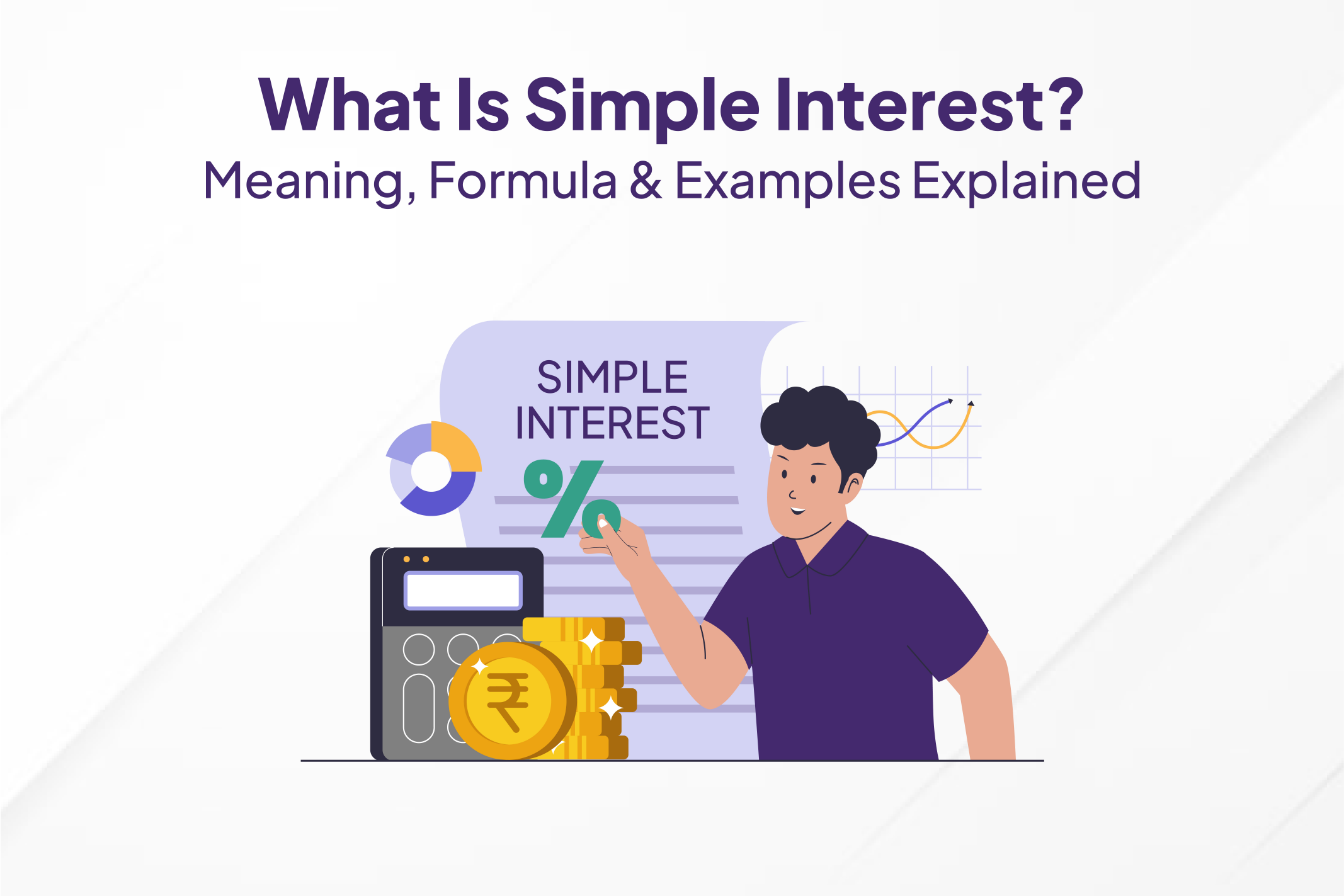
Simple interest is the interest charged or earned only on the original principal amount and not on previously accumulated interest. Because of its straightforward calculation method, it is commonly used for short-term loans, educational purposes, and basic financial calculations.
In simple terms, if you borrow ₹10,000 at a fixed interest rate, the interest is calculated only on ₹10,000 throughout the loan tenure, regardless of how long the loan runs.
Simple Interest Formula
The formula used to calculate simple interest is:
Simple Interest = (Principal × Rate × Time) ÷ 100
Where:
- P = Principal amount
- R = Annual interest rate
- T = Time period in years
Understanding this formula is the first step in learning how to calculate simple interest accurately for loans, deposits, or investments.
How to Calculate Simple Interest
If you are wondering how to calculate simple interest, follow these simple steps:
Step 1: Identify the principal amount: This is the original amount borrowed or invested.
Step 2: Determine the interest rate: Use the annual rate provided by the lender or investment institution.
Step 3: Calculate the time period: Measure the duration in years.
Step 4: Apply the formula: Multiply the principal, rate, and time, then divide the result by 100.
This method makes calculating simple interest straightforward, even without advanced financial tools.
Simple Interest Examples
Looking at practical simple interest examples can make the concept easier to understand.
Example 1: Personal Loan
Suppose you borrow ₹50,000 at an interest rate of 10% per annum for 2 years.
Simple Interest = (50,000 × 10 × 2) ÷ 100
Simple Interest = ₹10,000
Total repayment amount = ₹50,000 + ₹10,000 = ₹60,000
Example 2: Fixed Deposit
You invest ₹1,00,000 at 8% per annum for 3 years.
Simple Interest = (1,00,000 × 8 × 3) ÷ 100
Simple Interest = ₹24,000
Maturity amount = ₹1,24,000
These examples show how interest remains linked only to the original principal amount.
How to Find Rate of Interest in Simple Interest
Sometimes the principal, interest earned, and time period are known, but the interest rate is not.
If you are wondering how to find rate of interest in simple interest, use the formula:
Rate = (Simple Interest × 100) ÷ (Principal × Time)
Example
A borrower pays ₹6,000 as interest on a principal amount of ₹30,000 over 2 years.
Rate = (6,000 × 100) ÷ (30,000 × 2)
Rate = 10%
This formula helps determine the annual interest rate when other values are available.
Advantages of Simple Interest
Simple interest offers several benefits:
- Easy to calculate and understand
- Transparent borrowing costs
- Useful for short-term loans
- Predictable repayment structure
- Suitable for educational and financial planning purposes
Because of its simplicity, many borrowers prefer understanding loan costs through simple interest calculations before comparing financing options.
Simple Interest vs Compound Interest
| Feature | Simple Interest | Compound Interest |
|---|---|---|
| Calculation Base | Original principal only | Principal + accumulated interest |
| Growth Rate | Constant | Increases over time |
| Complexity | Easy | More complex |
| Suitable For | Short-term borrowing | Long-term investments |
| Total Interest Paid | Lower | Usually higher |
Understanding the difference helps borrowers choose financial products that align with their goals.
Where Is Simple Interest Used?
Simple interest is commonly used in:
- Short-term personal loans, making it useful to understand what is a personal loan and how interest is calculated on borrowed funds.
- Education loans, where simple interest concepts are often used to explain borrowing costs during study or moratorium periods.
- Vehicle loans in some cases, helping borrowers estimate the interest payable before comparing financing options.
- Fixed deposits, where investors can easily calculate expected returns over a specific investment period.
- Treasury bills, which use straightforward interest calculations to determine investment earnings.
- Basic financial calculations, making it easier to understand borrowing costs, investment returns, and interest-related concepts.
Most Indian personal loans do not use pure simple interest. Instead, lenders commonly apply either a flat interest rate or a reducing balance method. Under a flat rate, interest is calculated on the original loan amount throughout the tenure, while under a reducing balance method, interest is charged only on the outstanding principal after each repayment. Because the reducing balance method lowers the interest burden over time, it is generally considered more borrower-friendly. Even so, simple interest remains an important concept for understanding basic borrowing costs and financial calculations.
Simple Interest on Personal Loans
When discussing personal loans, it is important to understand how simple interest differs from actual loan repayment structures. Under a flat-rate simple interest method, interest is calculated on the entire original loan amount throughout the tenure. In contrast, most Indian personal loans use the reducing balance method, where interest is charged only on the outstanding principal after each EMI payment. As a result, an EMI calculated on a simple interest basis may differ from the actual amortisation schedule followed by lenders. Using a personal loan EMI calculator can help borrowers estimate their actual repayment obligations more accurately. Understanding this distinction helps borrowers accurately compare loan offers, estimate repayment costs, and make informed decisions about personal loan foreclosure if they plan to repay the loan early.
FAQs on Simple Interest
What is simple interest meaning?
Simple interest is interest calculated only on the original principal amount and not on accumulated interest.
How to calculate simple interest?
Use the formula: Simple Interest = (Principal × Rate × Time) ÷ 100.
What are some simple interest examples?
Examples include personal loans, fixed deposits, and educational calculations where interest is calculated only on the original principal amount.
How to find rate of interest in simple interest?
Use the formula: Rate = (Simple Interest × 100) ÷ (Principal × Time).
What is the difference between simple interest and compound interest?
Simple interest is calculated only on the principal amount, while compound interest is calculated on both the principal and accumulated interest.
Understanding simple interest helps borrowers evaluate loan costs and make better financial decisions. Whether you are taking a loan or planning an investment, knowing how interest is calculated can help you compare options more effectively and avoid surprises later.
| Personal Loans by City | ||||
|---|---|---|---|---|
| Personal Loan Bengaluru | Personal Loan Thane | Personal Loan Mumbai | Personal Loan Hyderabad | |
| Personal Loan Pune | Personal Loan Surat | Personal Loan Coimbatore | Personal Loan Delhi | |
| Personal Loans by Amount | ₹60,000 Personal Loan | ₹3 Lakh Personal Loan | ₹5 Lakh Personal Loan |
|---|