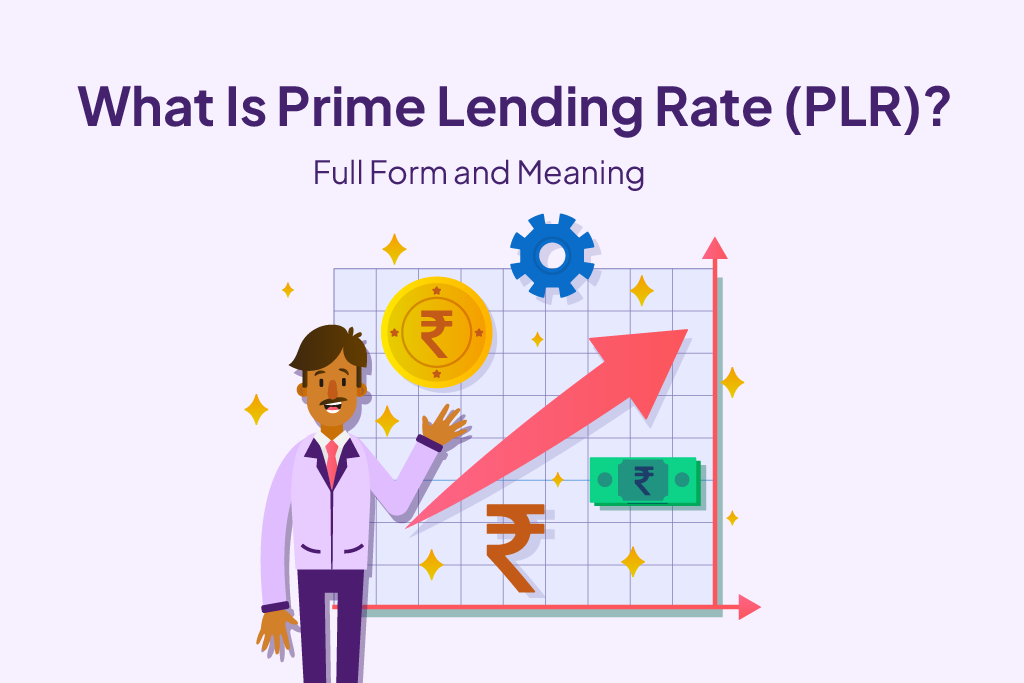
Every borrower eventually runs into an unfamiliar acronym on a loan document, and PLR is one of the more common ones. Here’s what it stands for, how it works, and why it still shows up in lending conversations even though most loans today are priced differently.
Understanding PLR can help you make sense of older loan agreements and compare them with modern benchmark-linked loans. It also gives you a clearer picture of how lending rates have evolved over time and what that means for borrowers today.
PLR Full Form
PLR stands for Prime Lending Rate, the benchmark interest rate a bank or NBFC charges its most creditworthy borrowers. Other loan rates are then priced above this benchmark, depending on the borrower’s risk profile, so understanding the full form of PLR is the first step to understanding how legacy loan pricing worked.
Prime Lending Rate Meaning
Simply put, the prime lending rate meaning comes down to this: it is the reference rate against which a lender used to price most of its lending products. A borrower with a strong credit history might get a rate close to the prime lending rate itself, while a riskier borrower would be charged prime lending rate plus a spread. This system made it a central, published number that lenders revised periodically based on their own cost of funds.
How Is Prime Lending Rate Calculated?
Unlike benchmark-linked lending rates that follow external reference rates, the Prime Lending Rate (PLR) is determined internally by each lender. It is based on the lender’s own cost structure and pricing strategy. Here’s how the calculation typically works:
- The lender assesses its cost of funds i.e. deposits, borrowings, and other sources of capital.
- A margin is added to cover operating costs and a reasonable profit for the lender.
- The resulting figure becomes the prime lending rate, published and reviewed periodically by the bank or NBFC.
- Individual loan rates are then set as the prime lending rate plus a spread that reflects the specific borrower’s or product’s credit risk.
- When the lender’s cost of funds changes, the prime lending rate is revised, and any loan still linked to it moves accordingly.
PLR vs MCLR vs Repo-Linked Rate
| Basis | PLR | MCLR | Repo-Linked Rate (RLLR) |
| Basis of calculation | Cost of funds plus margin, lender’s discretion | Marginal cost of funds, RBI-prescribed method | Directly linked to RBI’s repo rate |
| Transparency | Lower, largely at lender’s discretion | Moderate, formula-based but still lender-influenced | High, moves in step with a public policy rate |
| Era of use | Older system, largely phased out for retail loans | Introduced 2016, still used for some loans | Mandatory for most retail floating-rate loans since 2019 |
| Borrower impact | Rate changes were less frequent and less transparent | Rate changes tied to a formula reviewed periodically | Rate changes track RBI’s repo rate moves directly |
While PLR is no longer the benchmark for most new retail loans, you may still come across it in older loan agreements or legacy banking documents. Understanding the differences between these lending rates helps you better evaluate loan terms, anticipate interest rate changes, and make more informed borrowing decisions.
Why Prime Lending Rate Matters for Borrowers
Although the Prime Lending Rate is no longer the standard benchmark for most new retail loans, it continues to influence many existing loan accounts and lending discussions. Understanding its role can help you interpret loan pricing more confidently and make better borrowing decisions.
- Older loans still referencing the prime lending rate may reset less predictably than newer repo-linked loans
- Understanding the prime lending rate helps you make sense of why two lenders quote different rates for similar borrowers
- It explains one of several factors affecting personal loan interest rate decisions, alongside credit score and income
- Comparing a lender’s prime lending rate history can hint at how frequently it revises pricing overall
Which Loans Are Not Affected by Prime Lending Rate Changes?
Broadly, loans not affected by prime lending rate movements fall into three categories:
- Fixed-rate personal loans, where the rate is locked at disbursal regardless of any benchmark movement
- Loans already switched to a repo-linked benchmark, which follow RBI’s repo rate instead
- Loans nearing the end of their tenure, where a rate reset has limited practical impact on remaining EMIs
- It helps to understand the difference through a fixed vs floating interest rate comparison before assuming any of your loans move with this benchmark
Conclusion
The prime lending rate isn’t the dominant benchmark it once was, but it still surfaces in older loan agreements and in comparisons with newer, more transparent benchmarks like MCLR and the repo-linked rate. Knowing what is the prime lending rate and how to calculate the prime rate roughly helps you read any older loan document with more confidence.
FAQs on Prime Lending Rate
What is the full form of PLR?
PLR stands for Prime Lending Rate, the benchmark rate a lender uses as a starting point before adding a risk-based spread for individual borrowers.
How is prime lending rate different from repo rate?
The repo rate is set by the RBI as a monetary policy tool, while the prime lending rate is set independently by each bank or NBFC, though it’s often influenced by repo rate movements indirectly.
Does a PLR change affect my existing personal loan?
It depends on your loan structure. If your personal loan is still linked to the prime lending rate, a change can affect your EMI; if it’s fixed-rate or repo-linked, PLR movements won’t apply to it.
Who decides the prime lending rate?
Each bank or NBFC decides its own prime lending rate, based on its cost of funds and internal policies, unlike the repo rate, which the RBI sets centrally.
Is PLR still used by banks in India?
Its use has declined sharply since the introduction of MCLR and later the repo-linked rate, though some older loans and a related base rate framework still reference it for legacy pricing.
Related Posts
| Personal Loans by City | ||||
|---|---|---|---|---|
| Personal Loan Bengaluru | Personal Loan Thane | Personal Loan Mumbai | Personal Loan Hyderabad | |
| Personal Loan Pune | Personal Loan Surat | Personal Loan Coimbatore | Personal Loan Delhi | |
| Personal Loans by Amount | ₹60,000 Personal Loan | ₹3 Lakh Personal Loan | ₹5 Lakh Personal Loan |
|---|
Explore our latest Personal Loan blogs for expert insights, financial tips, and guidance to help you make informed borrowing decisions.