The Indian lending ecosystem has evolved significantly with the introduction of the co-lending model. By combining the strengths of banks, NBFCs, and fintech platforms, co-lending aims to improve credit access, reduce borrowing costs, and expand financial inclusion. Understanding co-lending can help borrowers and businesses better navigate modern lending solutions.
Co-Lending Meaning
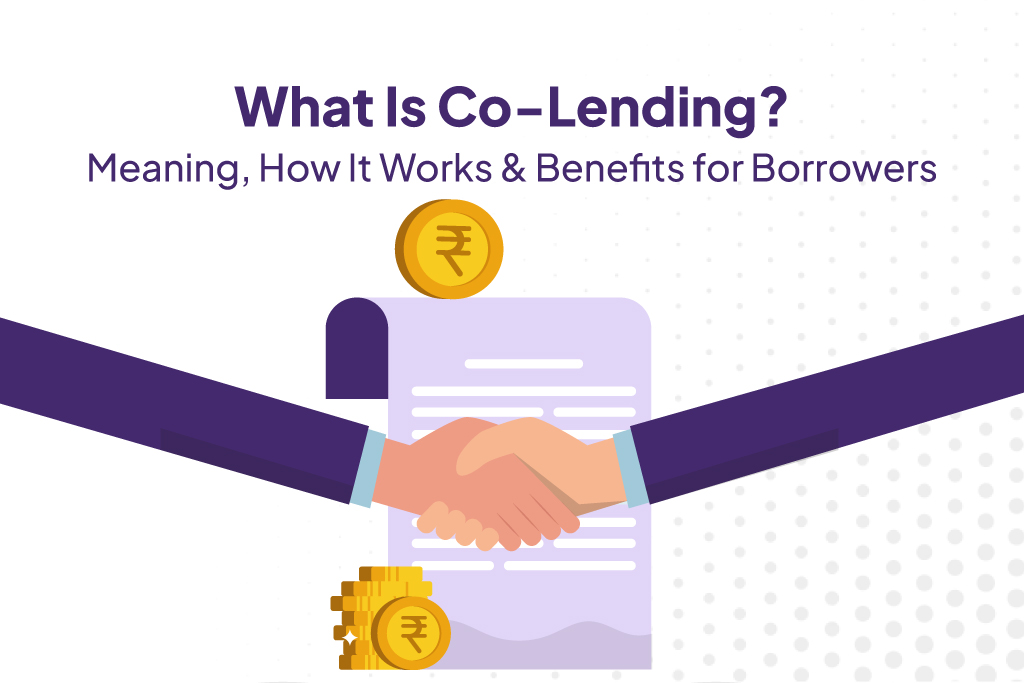
Co-lending is a model where a bank and a Non-Banking Financial Company (NBFC) jointly fund and originate a loan. The bank contributes 80% of the loan amount, while the NBFC funds the remaining 20%. The credit risk is also shared in the same 80:20 ratio as per RBI guidelines.
The co-lending meaning became more prominent after the Reserve Bank of India introduced the Co-Lending Model (CLM) framework in November 2020. The objective was to combine the low-cost capital of banks with the customer reach and underwriting expertise of NBFCs. If you are wondering what is co-lending, it is essentially a partnership that allows multiple financial institutions to work together in providing loans to borrowers.
How Co-Lending Works: Step by Step
Step 1: Customer Applies for a Loan
The borrower submits a loan application through an NBFC, fintech platform, or lending partner.
Step 2: Credit Assessment
The NBFC or originating institution evaluates the borrower’s eligibility, income, credit score, and repayment capacity.
Step 3: Loan Approval
Once the application meets the lending criteria, the loan is approved under the co-lending model.
Step 4: Funding Allocation
The bank contributes approximately 80% of the loan amount, while the NBFC contributes the remaining 20%.
Step 5: Loan Disbursement
The combined loan amount is disbursed to the borrower through a seamless process.
Step 6: Loan Servicing
The NBFC typically manages customer onboarding, collections, servicing, and borrower interactions.
Step 7: Repayment Collection
Borrowers repay EMIs as per the agreed schedule, and repayments are distributed between the bank and NBFC according to their participation ratio.
Step 8: Risk Sharing
Both institutions share the credit risk and returns associated with the loan.
This process explains how does co-lending work and why it has become increasingly popular across retail and business lending segments.
Key Benefits of Co-Lending
Benefits to Banks
Banks benefit from co-lending by gaining access to customer segments that may otherwise be difficult to serve directly. Many NBFCs have extensive reach in semi-urban and rural markets where traditional banking penetration is lower. Through co-lending partnerships, banks can expand their lending portfolios while leveraging the origination and servicing expertise of NBFCs.
Another advantage is improved deployment of capital. Since banks provide a significant portion of the funding, they can increase lending volumes without having to build extensive distribution networks. Co-lending also supports priority sector lending goals under regulatory frameworks.
Benefits to NBFCs
NBFCs gain access to lower-cost funding from banks, enabling them to offer more competitive loan products. This reduces their dependence on expensive borrowing sources and improves overall lending efficiency.
Co-lending allows NBFCs to scale operations, reach more customers, and increase loan disbursements without bearing the entire funding burden. It also strengthens their ability to compete in the rapidly evolving financial services market.
Benefits to Borrowers and Consumers
One of the biggest benefits of co-lending for borrowers is improved access to credit. Customers who may struggle to obtain financing through traditional channels can often access loans through co-lending partnerships. For borrowers exploring what is a personal loan and how modern lending works, co-lending partnerships can make personal loans more accessible through the combined strengths of banks and NBFCs.
Borrowers may also benefit from:
- Faster loan processing and approval.
- Competitive interest rates due to lower funding costs.
- Simplified digital application processes.
- Better customer service through fintech and NBFC partnerships.
- Increased availability of credit in underserved regions.
- Access to customized loan products tailored to specific needs.
By combining the strengths of banks and NBFCs, co-lending helps create a more efficient and inclusive lending ecosystem.
Types of Co-Lending Arrangements
There are several types of co-lending structures currently operating in India:
- RBI-Mandated CLM (Co-Lending Model): The standard 80:20 bank-to-NBFC funding structure primarily used for priority sector lending.
- Co-Origination Models: More flexible structures where funding ratios may vary based on lender agreements and loan categories.
- Fintech Co-Lending: Fintech platforms originate and process loans while banks or NBFCs provide the funding. This model is increasingly popular for personal loans and digital lending.
- Sector-Specific Co-Lending: Partnerships focused on agriculture, MSME, housing, or consumer finance segments.
Each structure is designed to address specific market requirements and lending objectives.
Future of Co-Lending
The future of co-lending in India appears promising as digital lending continues to expand. Advances in technology, data analytics, and digital underwriting are making co-lending partnerships more efficient and scalable. Regulators are also encouraging responsible innovation to improve financial inclusion.
As more banks, NBFCs, and fintech companies collaborate, co-lending is expected to play a significant role in increasing credit penetration across underserved customer segments. Before applying through any digital lending platform, borrowers should understand check if loan app is RBI registered and verify that the lending partner is a regulated bank or NBFC. The model has the potential to make borrowing faster, more affordable, and more accessible for millions of Indians.
FAQs on Co-Lending
What is co-lending in India?
Co-lending is a lending arrangement where a bank and an NBFC jointly fund and originate loans while sharing risks and returns according to agreed proportions.
How does a co-lending model work?
Under a co-lending model, the bank and NBFC jointly provide funding, while the NBFC typically manages customer acquisition, servicing, and collections.
How does the Co-Lending model help the lender?
The model allows lenders to expand customer reach, improve capital efficiency, reduce funding costs, and increase loan disbursement volumes.
What is the difference between co-lending and co-origination?
Co-lending generally follows RBI-prescribed frameworks and risk-sharing structures, while co-origination arrangements may allow more flexibility in funding participation and operational responsibilities.
Is FatakPay involved in co-lending?
Specific co-lending arrangements depend on FatakPay’s lending partnerships and product offerings. Borrowers should refer to the platform’s latest disclosures for details.
What is the RBI CLM framework for co-lending?
The RBI Co-Lending Model (CLM) framework, introduced in November 2020, provides guidelines for banks and NBFCs to jointly originate and fund loans while sharing risk.
What are the different types of co-lending models?
Common models include RBI CLM structures, co-origination partnerships, fintech-led co-lending arrangements, and sector-specific lending collaborations.
| Personal Loans by City | ||||
|---|---|---|---|---|
| Personal Loan Bengaluru | Personal Loan Thane | Personal Loan Mumbai | Personal Loan Hyderabad | |
| Personal Loan Pune | Personal Loan Surat | Personal Loan Coimbatore | Personal Loan Delhi | |
| Personal Loans by Amount | ₹60,000 Personal Loan | ₹3 Lakh Personal Loan | ₹5 Lakh Personal Loan |
|---|
Explore our latest Personal Loan blogs for expert insights, financial tips, and guidance to help you make informed borrowing decisions.