When applying for a personal loan, lenders evaluate several aspects of your financial profile rather than relying solely on your credit score and monthly income. They carefully assess your existing financial commitments, repayment history, and overall ability to manage debt responsibly. One of the most important metrics used in this evaluation is the Fixed Obligation to Income Ratio (FOIR). FOIR measures the proportion of your monthly income that is already allocated toward fixed financial obligations such as loan EMIs, rent, credit card payments, and other recurring commitments. By analysing this ratio, lenders can determine whether you have sufficient disposable income to comfortably take on and repay an additional loan without experiencing financial stress. As a result, FOIR plays a crucial role in assessing creditworthiness and significantly influences both loan approval decisions and the amount you may be eligible to borrow.
FOIR Full Form and Meaning
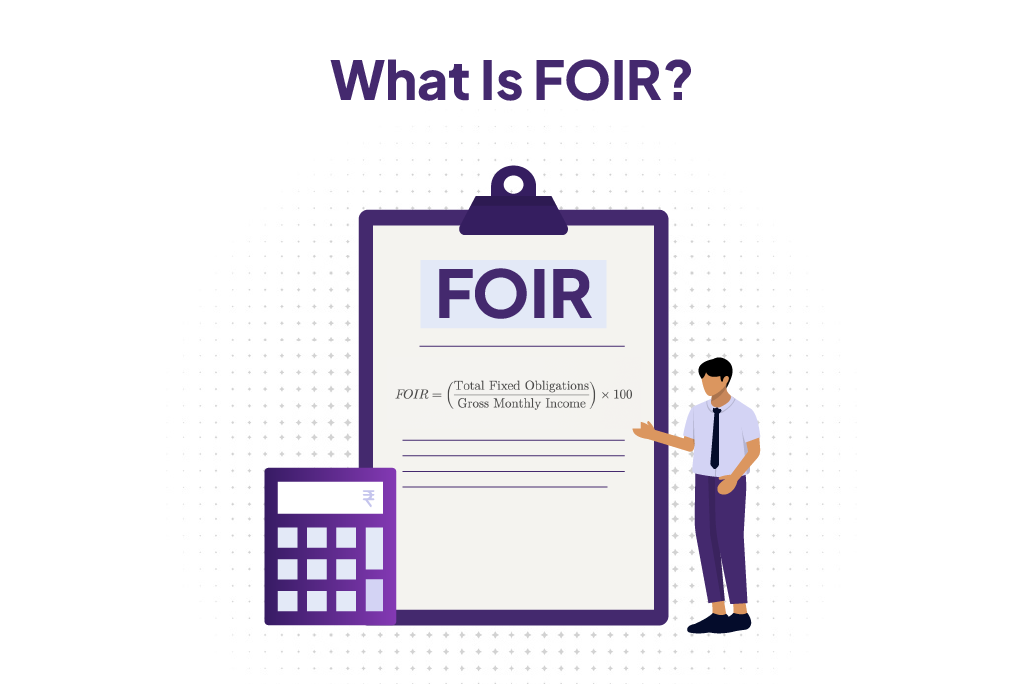
FOIR stands for Fixed Obligation to Income Ratio. It is a financial metric used by banks, NBFCs, and other lenders to measure how much of your gross monthly income is already allocated toward fixed financial commitments. These obligations typically include existing loan EMIs, house rent, credit card minimum payments, insurance premiums, and any other recurring debt-related expenses that must be paid every month. By calculating this ratio, lenders can get a clear picture of your current financial responsibilities and determine whether you have sufficient income left to comfortably repay a new loan. The fixed obligation to income ratio meaning becomes clearer when you compare your monthly debt commitments against your gross monthly income.
FOIR is a key indicator of a borrower’s repayment capacity. Lenders use it to assess existing financial obligations and determine whether an applicant can comfortably manage additional debt. A lower FOIR generally improves the chances of personal loan approval and better loan terms.
On the other hand, a higher FOIR indicates that a significant share of your income is already committed to existing expenses and debt repayments. This can signal to lenders that taking on another loan may put pressure on your finances and increase the risk of missed or delayed payments. In such cases, lenders may reduce the loan amount offered, charge a higher interest rate, request additional documentation, or even reject the application altogether. Therefore, maintaining a healthy FOIR is an important step toward improving your overall loan eligibility and financial stability. Many borrowers ask what is FOIR in loan applications, and lenders use this ratio to determine whether an applicant can comfortably handle additional debt obligations.
FOIR Formula and How to Calculate It
Understanding how to calculate FOIR can help borrowers assess their loan eligibility before applying with a bank or NBFC.
FOIR Formula:
FOIR = (Total Monthly Fixed Obligations ÷ Gross Monthly Income) × 100
If you are wondering how to calculate FOIR formula, simply divide your total monthly fixed obligations by your gross monthly income and multiply the result by 100.
Example 1
Monthly Income = ₹60,000
Monthly Obligations:
- Car EMI = ₹8,000
- Rent = ₹12,000
- Credit Card Minimum Payment = ₹5,000
Total Obligations = ₹25,000
FOIR = (₹25,000 ÷ ₹60,000) × 100 = 41.67%
This FOIR is generally considered acceptable by many lenders.
Example 2
Monthly Income = ₹60,000
Total Fixed Obligations = ₹35,000
FOIR = (₹35,000 ÷ ₹60,000) × 100 = 58.3%
Borrowers can also use a personal loan EMI calculator to estimate monthly repayments and understand how a new loan may affect their overall FOIR before applying.
A FOIR above 55% is generally viewed as high risk and may reduce the chances of loan approval.
What Does Your FOIR Mean for Loan Eligibility?
Understanding how lenders interpret different FOIR ranges can help you assess your chances of loan approval before applying. The table below provides a general overview of how various FOIR levels are viewed by lenders. To understand what is fixed obligation to income ratio, think of it as a measure of how much of your monthly income is already committed to recurring financial obligations.
| FOIR Range | Loan Eligibility Status | Lender View |
| Below 30% | Excellent | Very likely approved; best rates |
| 30-40% | Good | Approved at most lenders |
| 40-50% | Borderline | Approved at some lenders; lower loan amount |
| 50-55% | High Risk | Only flexible NBFCs or fintech lenders may approve |
| Above 55% | Likely Rejected | Most lenders decline |
The lower your FOIR, the stronger your loan eligibility generally becomes. Lenders also evaluate factors such as credit utilisation ratio and CIBIL score when assessing overall repayment capacity and creditworthiness. The importance of FOIR lies in its ability to help lenders evaluate repayment capacity and determine both loan approval chances and eligible loan amounts.
What Is Included in Fixed Obligations for FOIR?
Lenders may include several recurring financial commitments while calculating FOIR:
- Existing personal loan EMIs
- Home loan EMIs
- Car loan EMIs
- Education loan repayments
- Credit card minimum due amounts
- Monthly rent obligations
- Insurance premium payments
- Other recurring debt obligations
These fixed commitments are combined to determine how much of your monthly income is already allocated toward repayments.
How to Reduce FOIR Before Applying for a Loan
1. Close or Prepay Existing Small Loans
Paying off smaller loans can immediately reduce your monthly obligations and improve your FOIR. This is one of the most effective personal loan tips for salaried employees looking to strengthen their loan eligibility.
2. Reduce Credit Card Outstanding Balances
Lowering outstanding balances can reduce minimum payment requirements and improve repayment capacity.
3. Avoid New EMI Commitments
Avoid purchasing items on EMI or taking new loans for at least 3–6 months before applying for a major loan.
4. Apply Jointly with a Co-Borrower
Adding a co-borrower increases the total household income considered during evaluation, which may lower the overall FOIR.
5. Increase Your Income
Salary increments, bonuses, or additional income sources can improve your ratio by increasing the denominator in the FOIR calculation.
A lower FOIR not only improves approval chances but may also help borrowers qualify for larger loan amounts and better interest rates.
FAQs on FOIR
What is a good FOIR for personal loan approval in India?
Most lenders prefer a FOIR below 40%. Borrowers with FOIR below 30% are generally viewed very favourably.
How do I calculate my FOIR for a personal loan?
Add all monthly fixed obligations and divide the total by your gross monthly income. Multiply the result by 100 to calculate your FOIR percentage.
What is included in fixed obligations for FOIR calculation?
Fixed obligations typically include EMIs, rent, credit card minimum payments, insurance premiums, and other recurring debt commitments.
Can I still get a loan with FOIR above 50%?
Yes, some NBFCs and fintech lenders may approve applications with higher FOIR levels, although eligibility may be limited and loan amounts may be lower.
How does FOIR affect the loan amount I am eligible for?
A lower FOIR generally indicates stronger repayment capacity, which may increase the loan amount you qualify for and improve your chances of approval.
| Personal Loans by City | ||||
|---|---|---|---|---|
| Personal Loan Bengaluru | Personal Loan Thane | Personal Loan Mumbai | Personal Loan Hyderabad | |
| Personal Loan Pune | Personal Loan Surat | Personal Loan Coimbatore | Personal Loan Delhi | |
| Personal Loans by Amount | ₹60,000 Personal Loan | ₹3 Lakh Personal Loan | ₹5 Lakh Personal Loan |
|---|
💡 Explore our latest Personal Loan blogs for expert insights, financial tips, and guidance to help you make informed borrowing decisions.