Whenever you apply for a loan or credit card, lenders review your credit history before making a decision. This information comes from credit bureaus, which maintain records of your borrowing behaviour and repayment history. Understanding credit bureaus in India can help you build a strong credit profile and improve your chances of loan approval.
What Is a Credit Bureau?
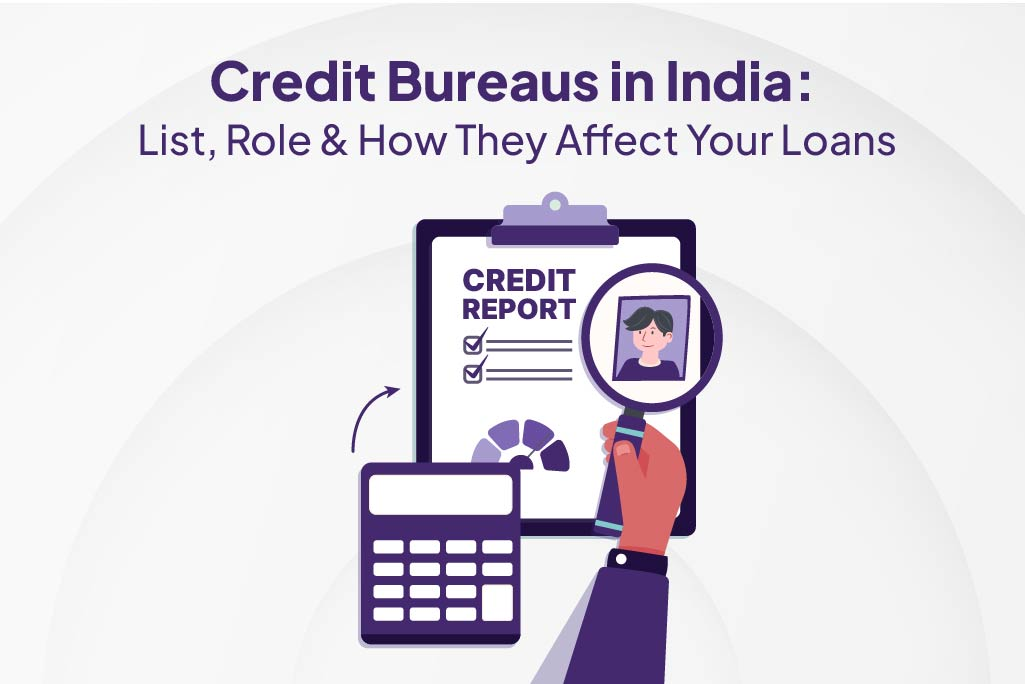
A credit bureau (also known as a Credit Information Company or CIC) is an RBI-licensed organisation that collects and maintains records of your borrowing and repayment behaviour. It compiles this information into a credit report and credit score that lenders use to assess your creditworthiness before approving loans or credit cards.
If you’re wondering what is a credit bureau, think of it as an independent organisation that tracks your credit history and provides lenders with an objective assessment of your repayment behaviour.
How Many Credit Bureaus Are There in India?
Many borrowers ask how many credit bureaus in India exist. India currently has four RBI-approved credit bureaus, all licensed and regulated under the Credit Information Companies (Regulation) Act, 2005.
The list of credit bureaus in India includes:
- TransUnion CIBIL
- Experian India
- Equifax India
- CRIF High Mark
These are the officially recognised RBI approved credit bureaus that maintain credit information for individuals and businesses.
The 4 Credit Bureaus in India – Full Comparison
| Credit Bureau | Founded in India | Score Range | Known For | Commonly Used By |
| TransUnion CIBIL | 2000 | 300–900 | India’s oldest and most widely accepted bureau | Most banks for home loans, personal loans, and mortgages |
| Experian India | 2010 | 300–900 | Advanced analytics and recent credit behaviour analysis | Fintech companies, NBFCs, digital lenders |
| Equifax India | 2010 | 300–900 | Portfolio analytics, fraud detection, commercial lending | Microfinance institutions, banks, commercial lenders |
| CRIF High Mark | Established 2007 (Licensed 2010) | 300–900 (1–10 for business) | Strong rural and microfinance coverage | Smaller NBFCs, microfinance institutions, rural lenders |
These top credit bureaus in India maintain similar credit information but use different scoring models and reporting methodologies.
What Each Credit Bureau Specialises In
TransUnion CIBIL
TransUnion CIBIL is the most widely recognised among the credit bureaus in India. It is the primary reference bureau for many banks offering home loans, car loans, and larger personal loans.
Experian
Experian is widely used by fintech companies and digital lenders because of its advanced analytics and quick credit assessment capabilities. It is particularly popular for instant personal loan approvals.
Equifax
Equifax specialises in commercial lending, fraud detection, portfolio analytics, and microfinance risk management. Many institutions rely on Equifax for broader credit risk analysis.
CRIF High Mark
CRIF High Mark has extensive coverage in rural lending, retail lending, and microfinance. It has developed strong expertise in evaluating borrowers from semi-urban and rural markets. If you primarily borrow from NBFCs or microfinance institutions, understanding what is CRIF credit score can help you interpret how lenders assess your creditworthiness.
Role of Credit Bureaus: What They Actually Do
The role of credit bureaus extends beyond simply generating credit scores. Their responsibilities include:
- Collect monthly repayment data from banks, NBFCs, and financial institutions.
- Compile this information into your Credit Information Report (CIR).
- Calculate your credit score using proprietary scoring algorithms.
- Share your credit report and score with lenders when you apply for loans or credit cards.
- Help lenders evaluate borrower risk and creditworthiness.
It is important to remember that credit bureaus do not approve or reject loan applications. They only provide credit information; the final lending decision is made by the lender.
Why Does My Score Differ Across the 4 Bureaus?
Many borrowers notice that their credit scores vary across different credit bureaus in India. This is completely normal and usually occurs for two reasons.
First, lenders may report your repayment data to each bureau on different reporting cycles. For example, one lender may update TransUnion CIBIL on the 1st of the month while reporting to Experian on the 15th. As a result, one bureau may have more recent information than another.
Second, each bureau uses its own proprietary credit scoring model. Although all four bureaus generally use a score range of 300–900, they assign different weightage to factors such as recent repayment behaviour, credit utilisation, credit mix, and account age, resulting in slight score variations.
If you notice a significant variation between the two most commonly used bureau scores, understanding the Experian vs CIBIL score difference can help explain why the same credit history may produce different scores.
How to Check Your Report from Each Bureau
Step 1
Visit the official website of the credit bureau whose report you wish to access.
Step 2
Register using your PAN, Aadhaar, mobile number, and email address.
Step 3
Complete identity verification through OTP authentication or other verification methods.
Step 4
Request your free annual credit report or purchase additional reports if required.
Step 5
Review your credit score, loan accounts, repayment history, enquiries, outstanding balances, and personal information carefully.
Step 6
If you notice incorrect information, raise a dispute directly with the respective credit bureau through its online dispute resolution portal.
Step 7
Continue monitoring your credit reports periodically from all four bureaus to ensure your information remains accurate and up to date.
Along with reviewing reports from all four bureaus, you should regularly check your CIBIL score free to monitor changes in your credit profile and identify any reporting errors early.
Conclusion
Understanding credit bureaus in India is essential for managing your financial health. The four RBI approved credit bureaus: TransUnion CIBIL, Experian, Equifax, and CRIF High Mark, play an important role in maintaining your credit history and supporting lenders in making informed lending decisions. By regularly checking your credit reports and maintaining responsible borrowing habits, you can improve your credit profile and enhance your chances of obtaining future loans at favourable terms.
FAQs on Credit Bureaus in India
What are the 4 credit bureaus in India?
The four licensed credit bureaus are TransUnion CIBIL, Experian India, Equifax India, and CRIF High Mark.
Which credit bureau do most Indian banks use?
Most banks primarily use TransUnion CIBIL, although many also obtain reports from Experian, Equifax, and CRIF High Mark depending on their lending policies.
Why is my credit score different across CIBIL, Experian, Equifax and CRIF?
Different reporting schedules and proprietary scoring algorithms cause slight variations in credit scores across bureaus.
Are credit bureaus regulated by the RBI?
Yes. All four credit bureaus operate under the Credit Information Companies (Regulation) Act, 2005, and are licensed and regulated by the Reserve Bank of India.
Can I get a free credit report from all 4 bureaus?
Yes. Individuals are generally entitled to receive one free credit report annually from each RBI-approved credit bureau.
Do credit bureaus decide whether my loan gets approved?
No. Credit bureaus only provide credit reports and credit scores. The lender makes the final decision regarding loan approval based on its own credit assessment policies.
| Personal Loans by City | ||||
|---|---|---|---|---|
| Personal Loan Bengaluru | Personal Loan Thane | Personal Loan Mumbai | Personal Loan Hyderabad | |
| Personal Loan Pune | Personal Loan Surat | Personal Loan Coimbatore | Personal Loan Delhi | |
| Personal Loans by Amount | ₹60,000 Personal Loan | ₹3 Lakh Personal Loan | ₹5 Lakh Personal Loan |
|---|
Explore our latest Credit Score blogs for expert insights, financial tips, and guidance to help you make informed borrowing decisions.