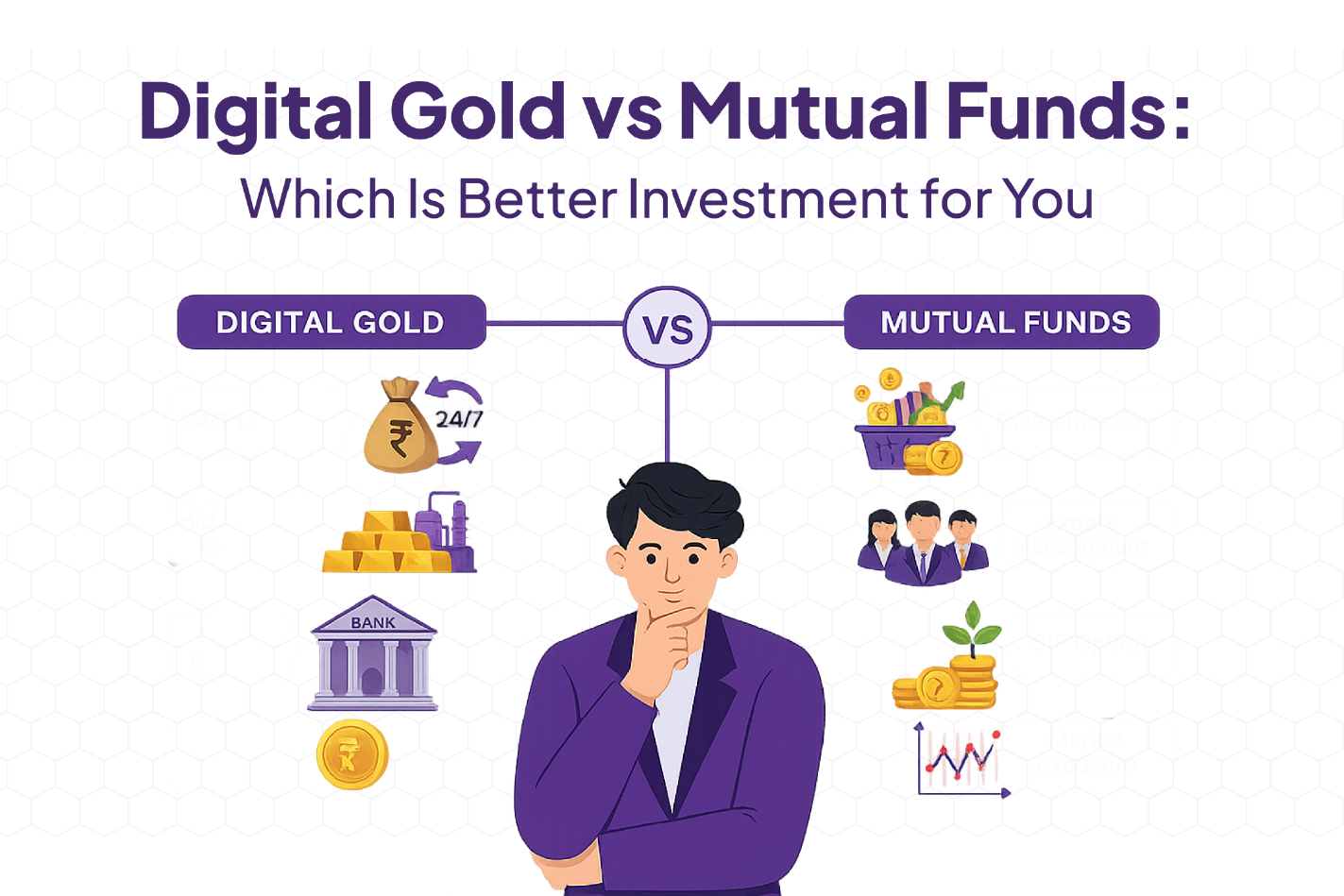
Two of the most popular investment options for Indian retail investors; digital gold and mutual funds, serve very different financial goals. One tracks a 5,000-year-old commodity; the other is powered by market-linked diversification. In the gold vs mutual fund debate, there is no universal winner, the right choice depends on your goal, risk appetite, and time horizon. FatakPay (RBI-registered | FACE member | ISO 27001 certified) breaks it down.
Quick Answer: Digital gold returns match gold price movements, approximately 13-15% CAGR over 10 years in India. Equity mutual funds have delivered 12-18% CAGR over the same period. Mutual funds have higher long-term return potential; digital gold is a safer inflation hedge with lower volatility.
What Is Digital Gold?
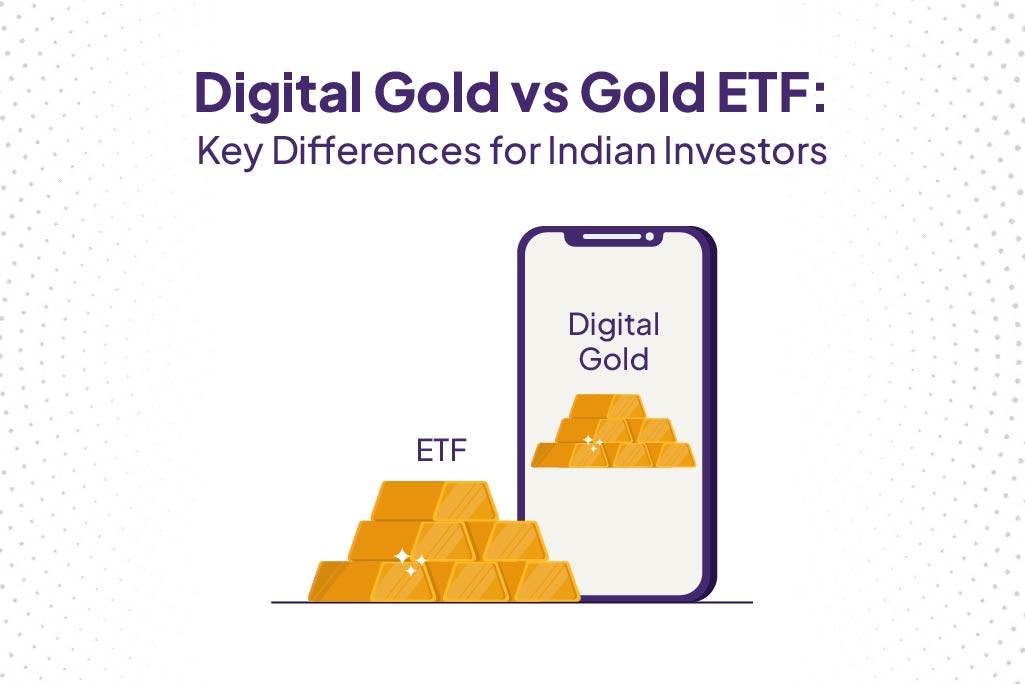
Digital gold is 24K physical gold (99.9% pure) purchased online and stored in insured vaults by certified custodians, MMTC-PAMP or SafeGold. You can buy from ₹10, sell at live gold market prices anytime, and optionally redeem as physical coins or bars. It is not regulated by SEBI or RBI, investor protection depends entirely on platform credibility. Gold mutual funds and Gold ETFs are SEBI-regulated alternatives to digital gold that track the same gold price without counterparty risk.
What Are Mutual Funds?
A mutual fund pools money from multiple investors and deploys it across a diversified portfolio; equities, debt, or commodities, managed by a SEBI-registered fund house. Equity mutual funds invest in stocks for long-term growth; debt funds invest in bonds for stability; gold mutual funds track gold prices through a SEBI-regulated structure. Returns are market-linked and not guaranteed. Systematic Investment Plans (SIPs) allow monthly investments from ₹100 or ₹500, making mutual funds accessible to first-time investors.
Digital Gold vs Mutual Funds
| Parameter | Digital Gold | Mutual Funds |
| Returns | Tracks gold price (~13–15% CAGR, 10Y) | Equity: 12–18% CAGR; Debt: 6–8%; Gold MF: ~13–15% |
| Liquidity | Instant, 24×7 at live market price | Equity/Debt: T+2 days; Liquid funds: same day |
| Risk | Low volatility; no SEBI protection | Market risk; SEBI-regulated investor protection |
| Tax (STCG) | Income slab rate (held < 24 months) | Equity: 20%; Debt/Gold MF: income slab rate |
| Tax (LTCG) | 12.5% (held > 24 months) | Equity: 12.5% above ₹1.25L; Gold MF: 12.5% |
| Regulation | Unregulated; no SEBI/RBI protection | SEBI-regulated; investor protection applies |
| Minimum Investment | ₹10 | ₹100–₹500 (SIP) |
Winner by dimension: Returns (long-term) → Equity Mutual Funds | Liquidity → Digital Gold | Safety (regulatory) → Mutual Funds | Inflation hedge → Digital Gold | Accessibility → Digital Gold (₹10 entry)
Historical Returns: Digital Gold vs Mutual Funds (1Y / 3Y / 5Y)
| Period | Digital Gold (Gold Price Return) | Nifty 50 Index (Equity) | Debt Mutual Funds |
| 1 Year (FY2024–25) | ~29% | ~5–7% | ~7–8% |
| 3 Years (CAGR) | ~17–19% | ~14–16% | ~6–7% |
| 5 Years (CAGR) | ~14–16% | ~16–18% | ~6–7% |
| 10 Years (CAGR) | ~13–15% | ~14–17% | ~6–7% |
Gold delivered approximately 29% return in FY2024-25 alone, significantly outperforming most equity funds in that year, though long-term equity CAGR (10 years) remains marginally higher. In gold vs mutual funds performance: gold wins in high-uncertainty periods (inflation, global crises, currency depreciation); equity wins over long, stable market cycles. A diversified portfolio typically includes both.
Risk Profile: Digital Gold vs Mutual Funds?
In the gold vs mutual fund risk debate, both have distinct risk profiles:
Digital Gold – Counterparty Risk (Unregulated by SEBI)
Digital gold carries zero price volatility risk compared to equities, but it carries platform and custodian risk that equity funds do not. SEBI has no jurisdiction over digital gold products, if the platform or custodian fails, recovery is a legal process, not a regulatory guarantee. Gold ETFs and Gold Mutual Funds are SEBI-regulated and eliminate this counterparty risk entirely while tracking the same gold price.
Mutual Funds – Market Risk (SEBI Regulated)
Equity mutual funds carry market risk, NAV can fall during market downturns but SEBI regulation ensures fund house compliance, independent auditing, and investor protection mechanisms. Debt mutual funds carry lower market risk but are not capital-protected. The regulatory safety net makes mutual funds the more secure structure for long-term wealth building.
Tax Treatment: Digital Gold vs Mutual Funds
| Category | Digital Gold | Equity Mutual Funds | Gold Mutual Funds |
| Holding < 24 months (STCG) | Taxed at income slab rate | 20% flat | Taxed at income slab rate |
| Holding > 24 months (LTCG) | 12.5% without indexation | 12.5% above ₹1.25L | 12.5% without indexation |
| GST on purchase | 3% | None | None |
| Exit load | Buy-sell spread (2–3%) | 1% within 1 year (equity); varies | Varies |
Tax verdict in digital gold investment vs mutual fund: Digital gold and gold mutual funds carry similar tax treatment, but digital gold also attracts 3% GST at purchase, making it less tax-efficient than Gold ETFs or Gold Mutual Funds for larger, long-term investments.
Digital Gold or Mutual Funds?
Choose digital gold if you:
- Want pure gold exposure with no demat account or documentation required
- Prefer investing small, irregular amounts, ₹10 to ₹1,000 without SIP commitments
- Need 24×7 instant liquidity at live gold market prices
- Are investing for a short-to-medium-term goal (1–3 years) tied to gold price appreciation
- Want to accumulate gold systematically for a wedding, festival, or tangible financial milestone
Who Should Choose Mutual Funds?
Choose mutual funds if you:
- Are investing for long-term wealth creation (5+ years) where equity CAGR outperforms gold
- Want SEBI-regulated investor protection on your investments
- Prefer systematic, goal-based investing with tax-efficient SIP structures
- Need debt or balanced fund options for stable, lower-volatility returns
- Want gold exposure without counterparty risk, use a Gold ETF or Gold Mutual Fund instead of digital gold
FAQs
Which Gives Better Returns: Digital Gold or Mutual Funds in India?
Over 10 years, equity mutual funds have delivered 14–17% CAGR vs gold’s 13–15% CAGR, a marginal difference. However, in high-inflation years like FY2024–25, gold vs mutual funds returns inverted sharply, with gold delivering ~29% vs equity’s ~5–7%. Both belong in a balanced portfolio; neither consistently dominates across all market cycles.
Is Digital Gold or SIP Better for Long-Term Wealth Creation?
For pure long-term wealth creation (10+ years), equity SIPs historically outperform gold. However, gold SIPs serve a different purpose, capital preservation and inflation hedging, rather than aggressive growth. Most financial advisors recommend allocating 5–15% of a portfolio to gold (via digital gold or Gold ETF) and the remainder to equity and debt mutual funds.
Is Gold a Better Hedge Against Inflation Than Mutual Funds?
Yes, gold has historically been a stronger short-to-medium-term inflation hedge than equity mutual funds. When inflation rises sharply or the rupee depreciates, gold prices typically rise in rupee terms, protecting purchasing power. Equity mutual funds hedge inflation better over 10+ year horizons through compounding, but underperform gold during sharp inflationary spikes.
Can I Do a SIP in Digital Gold?
Yes. Most digital gold platforms including FatakPay, allow recurring gold purchases on a weekly or monthly schedule, functioning like a gold SIP. Rupee cost averaging applies, smaller purchases across time average out gold price fluctuations. This is ideal for first-time investors building a gold corpus systematically without lump-sum timing pressure.
What Are the Tax Differences Between Digital Gold and Mutual Funds?
Digital gold and gold mutual funds carry similar LTCG treatment (12.5% after 24 months), but digital gold also attracts 3% GST at purchase, a cost gold mutual funds do not carry. Equity mutual funds tax LTCG at 12.5% above ₹1.25 Lakh annually. For larger, long-term gold investments, Gold ETFs and Gold Mutual Funds are more tax-efficient than digital gold.
| Instant Loans by Amount | |||
|---|---|---|---|
| ₹1500 Instant Loan | ₹2500 Instant Loan | ₹5000 Instant Loan | ₹10000 Instant Loan |
| ₹12500 Instant Loan | ₹15000 Instant Loan | ₹17500 Instant Loan | ₹20000 Instant Loan |