Gold has always been central to Indian households, be it for savings, celebrations, or security. But today, investors face a new choice: digital gold vs physical gold. Both represent real gold, but they differ significantly in cost, safety, convenience, and tax treatment. This guide breaks down everything you need to know before you invest.
Quick Answer: Digital gold is 24K gold stored in insured vaults, bought online from as little as ₹10. Physical gold is tangible, jewellery, coins, bars, stored and managed by you. Digital gold suits small, flexible investors; physical gold suits those who want tangible ownership. Both attract 3% GST and capital gains tax on profits.
What is Physical Gold?
Physical gold is the traditional form of gold investment in India, bought as jewellery, coins, or bars and held in your possession. It has deep cultural significance, used widely for weddings, gifting, and festivals. Physical gold is universally accepted, instantly recognisable, and requires no technology or platform to access. However, physical gold investments come with additional costs that are often underestimated including making charges, storage, and insurance.
Types of Physical Gold: Jewellery, Coins, Bars
The three most common forms are gold jewellery (the most popular but least pure for investment purposes), gold coins (typically 24K and sold by banks and jewellers), and gold bars (higher quantities, better for large-scale investment). Each form has different making charges, resale values, and storage considerations.
Purity Standards: BIS Hallmark, 22K vs 24K
Gold purity is measured in karats (K). Jewellery is typically 22K (91.6% pure gold), while coins and bars are 24K (99.5–99.9% pure). The Bureau of Indian Standards (BIS) Hallmark certification is the Indian government’s guarantee of purity. Always look for the BIS Hallmark when buying physical gold to ensure you’re not being sold impure gold at a premium.
What is Digital Gold?
Digital gold is pure 24K gold purchased online through a digital platform. When you buy digital gold, the equivalent weight in physical gold is purchased on your behalf and stored in a secured, insured vault by a custodian like MMTC-PAMP or SafeGold. You own the gold; the platform holds it. You can sell at live market prices any time, or redeem as physical gold coins and bars on supported platforms.
How Digital Gold Works: Purchase → Vault Storage → Redeem
The process is straightforward: you select an amount (starting from ₹10), purchase at the live market rate, and your equivalent gold weight is immediately allocated and stored in an insured vault. You can track your holdings in real time, sell whenever you want at the current market price, or request physical delivery as gold coins or bars above a minimum threshold.
Platforms Offering Digital Gold in India (MMTC-PAMP, SafeGold, etc.)
In India, digital gold is primarily backed by two custodians: MMTC-PAMP (a joint venture between MMTC Limited and PAMP Switzerland) and SafeGold (by Digital Gold India Pvt. Ltd.). These are available through various online platforms and fintech apps, including FatakPay. Each platform charges a small spread (buy-sell price difference) and may levy a storage fee after a holding period.
Digital Gold vs Physical Gold: Side-by-Side Comparison
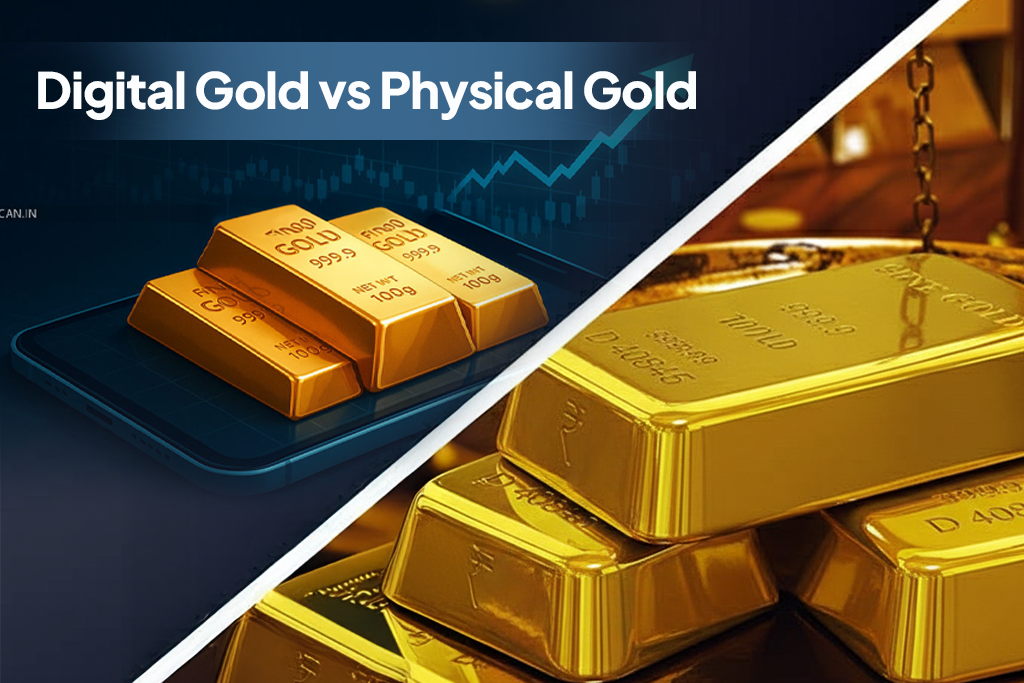
Here is a clear head-to-head breakdown of physical gold vs digital gold across every parameter that matters to investors:
| Parameter | Digital Gold | Physical Gold |
| Storage & Safety | Insured vaults managed by custodian; zero theft risk | Self-managed; requires locker or home storage |
| Purity Guarantee | Always 24K (99.9%) certified by custodian | Varies; 22K for jewellery, 24K for coins/bars; check BIS Hallmark |
| Minimum Investment | As low as ₹10 | Typically ₹5,000+ for coins; jewellery higher |
| Liquidity | Instant buy/sell at live market price, any time | Depends on jeweller; resale may involve deductions |
| Costs | 3% GST + platform spread; storage fee after 5 years (varies) | 3% GST + making charges (5–25%) + wastage |
| Regulation | Not regulated by SEBI or RBI; platform-dependent | Not regulated specifically; BIS governs purity |
| Usage | Investment-only; can redeem as physical | Can be worn, gifted, pledged for loans |
| Tax Treatment | STCG if sold within 24 months; LTCG at 12.5% beyond | Same as digital gold; STCG or LTCG applies |
Taxation on Digital Gold vs Physical Gold
Tax treatment is identical for both forms of gold in India, the difference between digital gold and physical gold disappears entirely for the Income Tax Department.
| Holding Period | Tax Type | Rate |
| Less than 24 months | Short-Term Capital Gain (STCG) | Added to income; taxed at applicable income slab |
| More than 24 months | Long-Term Capital Gain (LTCG) | 12.5% without indexation (post-Budget 2024) |
Note: 3% GST applies at the time of purchase for both digital and physical gold. No GST applies at the time of sale. Making charges on jewellery are taxed at 5% GST additionally. There is no TDS on gold sales by individuals unless transaction thresholds are crossed. Sovereign Gold Bonds (SGBs), a separate category, offer tax-exempt LTCG if held to maturity, making them more tax-efficient than both digital and physical gold.
Comparison That Matters to Investors
When evaluating the difference between physical and digital gold from a pure investment standpoint, five factors stand out.
Cost efficiency: Physical gold, particularly jewellery, carries a significant cost drag. Making charges alone can add 10-25% to the purchase price, and you recover none of this at resale. Digital gold has no making charges. The only costs are the 3% GST at purchase and a small platform spread. For pure wealth accumulation, digital gold is the more cost-efficient vehicle.
Purity certainty: Every unit of digital gold is guaranteed 24K (99.9%) pure by the custodian. Physical gold purity depends on the seller and whether BIS Hallmark verification is present. Hallmarked gold is safer, but the verification burden lies with the buyer.
Counterparty risk: This is where the difference between digital and physical gold matters most. Physical gold has zero counterparty risk, you own it outright. Digital gold carries platform risk: if the custodian or platform fails, recovery depends on the legal structure in place. SEBI has cautioned (November 2025) that digital gold products are not regulated, investors rely solely on platform credibility and the terms of the custodian agreement.
Liquidity and flexibility: Digital gold wins decisively here. You can invest ₹50 during a lunch break and sell it the next morning at live market prices. Physical gold requires a visit to a jeweller, often with haircut-style deductions on resale.
Portfolio accessibility: Digital gold is more suited to systematic, habit-based investing, similar to a recurring deposit but in gold. Physical gold investments are typically lump-sum purchases driven by occasion rather than financial strategy.
Use Cases
Understanding physical vs digital gold becomes clearest when you look at real-world use cases.
Choose digital gold if:
- You want to invest in digital gold in small, regular amounts, as low as ₹10 per transaction, without a large upfront commitment
- You are building a gold corpus for a future goal (children’s education, wedding, down payment) and want to accumulate gradually
- You want guaranteed 24K purity without having to verify hallmarks or trust a jeweller
- You want instant liquidity, the ability to sell gold and receive cash within the same day
- You don’t want the logistical burden of storing gold at home or paying locker charges at a bank
- You’re an online-first investor who prefers tracking holdings through an app in real time
Choose physical gold if:
- You need gold for a specific purpose, gold jewellery for a wedding, gold coins as a gift, or gold bars as a family heirloom
- You value tangible ownership above all else, and the ability to access your gold without a platform or internet connection
- You want to pledge your gold against a loan (gold loans are available only on physical gold; digital gold cannot be pledged directly in most cases)
- You are buying on behalf of elders or family members who prefer traditional forms and are not comfortable with digital platforms
- You are making a large, one-time purchase where the making-charge disadvantage is outweighed by the utility of the physical asset
For most salaried individuals and first-time investors in India, digital gold offers a more accessible, cost-efficient, and lower-friction entry point into gold investing. For those with cultural, practical, or utility-driven needs, physical gold remains irreplaceable.
Already own gold? FatakPay offers instant personal loans up to ₹20,000 without pledging any gold, with no collateral, and 7-minute disbursal, approved with a CIBIL score of 650+.
Frequently Asked Questions
Is Digital Gold Safer Than Physical Gold in India?
Both have different risk profiles. Physical gold has zero counterparty risk, you own it outright and the only risks are theft or damage. Digital gold is stored in insured vaults, eliminating theft risk, but introduces platform and custodian risk.
SEBI has cautioned (November 2025) that digital gold is unregulated, only invest through established platforms backed by credible custodians like MMTC-PAMP or SafeGold.
Is Digital Gold Regulated by SEBI or RBI?
No. As of now, digital gold is not regulated by SEBI or RBI in India. SEBI had previously restricted mutual funds from investing in digital gold, and in November 2025, SEBI reiterated cautions about the unregulated nature of digital gold products.
This means investor protections are limited to the platform’s terms and the custodian’s legal agreement, not statutory regulation.
Can I Convert My Digital Gold to Physical Gold?
Yes, on most platforms. Platforms backed by MMTC-PAMP or SafeGold allow you to request delivery of your digital gold holdings as physical gold coins or bars, subject to a minimum weight threshold (typically 0.5g or 1g) and applicable delivery/minting charges. The gold is hallmarked and delivered to your registered address.
Which Has Better Returns? Digital Gold or Physical Gold
Both track the same underlying gold price, so long-term returns are nearly identical. The difference is in costs: physical gold’s making charges (especially jewellery) reduce effective returns significantly.
Digital gold’s lower cost structure means more of your money actually buys gold. For pure investment returns, digital gold has the edge; Sovereign Gold Bonds (SGBs) offer an additional 2.5% annual interest, making them the most return-efficient gold instrument if held to maturity.
What Is the Minimum Amount to Invest in Digital Gold?
Most platforms allow you to buy digital gold starting from ₹10. On FatakPay, you can start investing in digital gold from ₹10 at live market rates with no minimum holding requirement. This makes it accessible to anyone, including first-time investors building a habit before committing larger amounts.
Is Digital Gold a Good Investment for the Long-Term?
Digital gold is a reasonable long-term store of value, tracking real gold prices with guaranteed 24K purity and low entry costs. However, for long-term investment (5+ years), Sovereign Gold Bonds (SGBs) are generally superior, they offer the same price appreciation plus 2.5% annual interest and tax-free LTCG if held to maturity. Digital gold works best as a flexible, accessible entry point or a short-to-medium-term gold accumulation tool.
Do I Pay GST on Digital Gold Purchases?
Yes. A 3% GST applies on every digital gold purchase, just as it does on physical gold. This is a one-time charge at purchase, there is no GST when you sell. For jewellery, an additional 5% GST applies on making charges. When comparing total acquisition costs, digital gold (3% GST only) is considerably cheaper than gold jewellery (3% GST + 5% GST on making charges + the making charge itself).
Want instant access to cash without selling your gold? FatakPay offers personal loans up to ₹5 Lakh with no collateral; apply in minutes with a 650+ CIBIL score.
| Personal Loans by City | ||||
|---|---|---|---|---|
| Personal Loan Bengaluru | Personal Loan Thane | Personal Loan Mumbai | Personal Loan Hyderabad | |
| Personal Loan Pune | Personal Loan Surat | Personal Loan Coimbatore | Personal Loan Delhi | |
| Personal Loans by Amount | ₹60,000 Personal Loan | ₹3 Lakh Personal Loan | ₹5 Lakh Personal Loan |
|---|