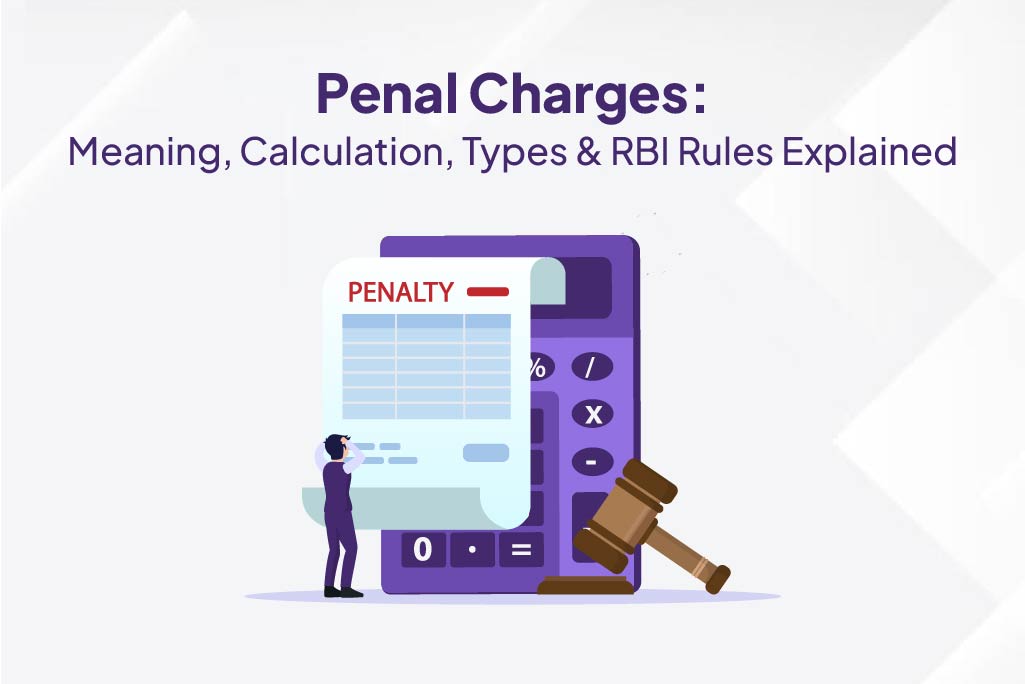
Missing a loan payment does not only result in an overdue amount. Lenders may also apply penal charges for violating the terms of a loan agreement. Whether it is a delayed EMI, a bounced auto-debit mandate, or another form of default, these additional fees can increase borrowing costs. Understanding penal charges helps you avoid unnecessary expenses and maintain a healthy credit profile.
What Are Penal Charges?
Penal charges are fees imposed by lenders when a borrower fails to meet contractual loan obligations, such as missing an EMI, maintaining insufficient funds for auto-debit, or breaching other loan terms. If you are wondering what “penal charges” are, it refers to the additional amount charged over and above the regular repayment obligation when a default occurs.
The penal charge’s meaning is different from regular loan interest. Regular interest is the cost of borrowing money, while penal charges in loan agreements are levied as a consequence of non-compliance with agreed terms. These charges may vary depending on the lender, loan type, and the nature of the default.
Types of Penal Charges
While reviewing the different types of penalties applicable on loans, it is also important to understand that these charges are separate from other borrowing costs. For example, personal loan processing fee and charges are typically levied when the loan is sanctioned, whereas penal charges arise only when loan terms are breached.
1. Late Payment Penalty / Penal Interest
This charge applies when an EMI is not paid by the due date. Lenders may levy a fixed fee or additional interest on the overdue amount until payment is made.
2. Cheque or NACH Bounce Charge
When a post-dated cheque or auto-debit mandate is dishonoured due to insufficient funds, lenders impose bounce charges. These fees typically range from ₹300 to ₹1,000 per instance, depending on the lender.
3. Prepayment Penalty
Some loans may include a fee if the borrower repays the entire outstanding amount before the scheduled tenure ends. This compensates the lender for the loss of expected interest income.
4. Part-Prepayment Charge
Certain lenders charge a fee when borrowers make partial repayments beyond the regular EMI schedule. The charge structure varies across loan products.
Read more about personal loan foreclosure charges and the factors lenders consider when a loan is closed before the end of its tenure.
5. Default Penal Charge
When a loan remains overdue for an extended period, especially beyond 90 days, lenders may apply additional default-related charges. Such accounts may also be classified as non-performing assets (NPAs) based on regulatory guidelines.
How Are Penal Charges Calculated?
Many borrowers ask, how are penalty charges calculated on overdue loan payments? The calculation method depends on the lender’s policy and the nature of the default.
For delayed EMIs, lenders often apply penal interest at a rate of 2% per month on the overdue amount.
Formula: Penal Charge = Overdue Amount × Penal Rate × (Number of Days Overdue ÷ Days in Month)
Example:
- Overdue EMI: ₹10,000
- Penal rate: 2% per month
- Delay: 15 days
Penal charge = ₹10,000 × 2% × (15 ÷ 30)
Penal charge = ₹100
In addition, applicable GST rates may apply to penal charges, increasing the final amount payable.
If you are evaluating how penal charges are calculated, always check the lender’s schedule of charges because methods may differ across financial institutions.
As per the 2023 guidelines issued by the Reserve Bank of India, lenders should levy penalties that are reasonable and proportionate to the nature of the default rather than using them as a revenue-generating mechanism.
How Penal Charges Affect Your CIBIL Score
Penal charges do not directly impact your credit score. However, ignoring them can create larger repayment issues.
When overdue amounts remain unpaid, the lender may report payment delays to credit bureaus. This increases the Days Past Due (DPD) record and can negatively affect your credit profile. As outstanding dues accumulate, your credit score may decline, making future borrowing more difficult.
To avoid credit damage, pay overdue EMIs and associated penal charges in loan accounts as soon as possible.
Conclusion
Understanding penal charges is essential for managing loans responsibly. If you plan to apply for personal loan with transparent charges, always review the Key Facts Statement (KFS), which outlines applicable fees, interest rates and penal charges. FatakPay clearly discloses all applicable charges in the KFS before loan disbursal, helping borrowers make informed decisions.
FAQs
What are penal charges in a loan?
Penal charges in loan agreements are additional fees imposed when a borrower fails to comply with loan terms, such as delayed EMI payments, bounced mandates, or other contractual breaches.
What is the difference between penal charges and penal interest?
Penal charges generally refer to fixed penalties imposed for defaults. Penal interest refers to additional interest charged on overdue amounts. The exact treatment depends on the lender’s policy and regulatory requirements.
How are penal charges calculated on a personal loan?
The calculation depends on the lender. For overdue EMIs, lenders commonly apply a percentage-based charge on the outstanding amount for the duration of the delay. If you are asking how penal charges are calculated, refer to your loan agreement for the exact method.
What are the RBI rules on penal charges for loans?
The RBI requires regulated lenders to ensure that penalties are reasonable, transparent, and proportionate to the default. Lenders must clearly disclose the applicable charges to borrowers.
Can penal charges affect my CIBIL score?
The charges themselves do not directly impact your score. However, unpaid dues and prolonged delays associated with those charges can lead to negative reporting and lower credit scores.
What is a NACH bounce charge?
A NACH bounce charge is a penalty levied when an auto-debit instruction fails due to insufficient funds, account restrictions, or other banking issues. It is one of the most common penalty charges applied on loans.
| Personal Loans by City | ||||
|---|---|---|---|---|
| Personal Loan Bengaluru | Personal Loan Thane | Personal Loan Mumbai | Personal Loan Hyderabad | |
| Personal Loan Pune | Personal Loan Surat | Personal Loan Coimbatore | Personal Loan Delhi | |
| Personal Loans by Amount | ₹60,000 Personal Loan | ₹3 Lakh Personal Loan | ₹5 Lakh Personal Loan |
|---|
💡 Explore our latest Personal Loan blogs for expert insights, financial tips, and guidance to help you make informed borrowing decisions.