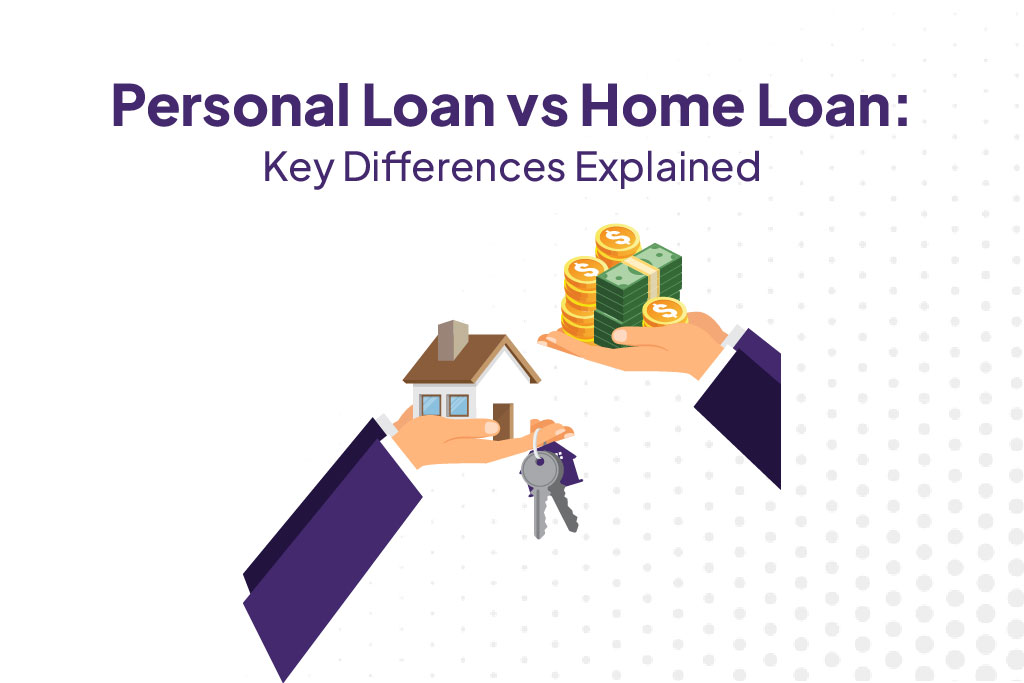
Personal loans and home loans are among the most common borrowing options in India, but they are designed to serve very different financial needs. A personal loan is generally used for short-term or immediate expenses such as medical emergencies, weddings, travel, education, debt consolidation, or home improvements, whereas a home loan is specifically intended for purchasing, constructing, renovating, or extending a residential property.
Although both loan products provide borrowers with access to funds, they differ significantly in several important aspects, including collateral requirements, interest rates, loan amounts, repayment tenure, eligibility criteria, tax benefits, and approval procedures.
One of the biggest distinctions is that personal loans are usually unsecured, meaning borrowers do not need to pledge any asset as security, while home loans are secured loans where the property being financed acts as collateral. This difference directly impacts the interest rates charged by lenders, with home loans typically offering lower rates due to the reduced risk involved.
Home loans also generally provide higher borrowing limits and longer repayment tenures, making them suitable for large property-related investments, whereas personal loans are often preferred for their flexibility and faster disbursal. Understanding these differences is essential for making informed borrowing decisions, managing finances effectively, and choosing a loan that aligns with individual financial goals and repayment capacity.
Understanding the difference between personal loan and home loan is important because both serve different financial purposes and come with different costs, eligibility requirements, and repayment structures.
What Is a Personal Loan?
A personal loan is an unsecured loan that can be used for almost any purpose, including medical emergencies, travel, education, weddings, or home renovation. Approval is largely based on your income, CIBIL score, and repayment capacity. Personal loans typically range from ₹20,000 to ₹40 lakh, have repayment tenures of 1–5 years, and are known for their fast approval and disbursal process.
Since no collateral is required, lenders generally place greater emphasis on the borrower’s credit history and monthly income when assessing eligibility. Borrowers with strong credit profiles may qualify for higher loan amounts and more competitive interest rates, while those with lower credit scores may face stricter terms or reduced approval chances. To understand the concept in detail, read our guide on what is a personal loan.
What Is a Home Loan?
A home loan is a secured loan where the property being purchased, constructed, or renovated acts as collateral. Understanding the difference between a secured loan vs unsecured loan can help borrowers compare home loans with personal loans more effectively. It is purpose-specific and can only be used for approved housing-related needs.
Home loans often range up to ₹5 crore or more, offer lower interest rates than personal loans, and come with longer repayment tenures of 15-30 years. However, the approval process is more detailed and usually takes longer. Lenders typically assess factors such as the property’s legal status, market value, the borrower’s income, employment stability, and credit history before approving a home loan.
Because the property serves as security, borrowers may be eligible for higher loan amounts compared to unsecured borrowing options, making home loans a preferred choice for financing residential real estate purchases.
Personal Loan vs Home Loan – Comparison Table
The table below highlights the major differences between personal loans and home loans:
| Feature | Personal Loan | Home Loan |
| Purpose | Any personal or financial requirement | Purchase, construction, or renovation of property |
| Collateral | Not Required | Property acts as collateral |
| Interest Rate | Usually 10%-26% p.a. | Usually 8.5%–10.5% p.a. |
| Loan Amount | ₹20,000 to ₹40 lakh (varies by lender) | Up to ₹5 crore or more |
| Tenure | 1-5 years | 15-30 years |
| Approval Time | Fast, often within hours or days | Slower due to property verification |
| Tax Benefit | Limited, available only in certain cases | Available under Sections 80C and 24(b) |
| Prepayment | May attract charges depending on lender | Often flexible, subject to lender terms |
| CIBIL Needed | Important for approval | Important, but property also matters |
| EMI | Higher due to shorter tenure | Lower due to longer tenure |
Although home loans generally offer lower interest rates, they involve longer commitments and stricter eligibility checks.
Interest Rate Reality Check – Which Actually Costs More?
At first glance, home loans appear much cheaper because their interest rates generally range between 8.5% and 10.5% per annum, while personal loan rates can range from 10% to 26% per annum. However, the total cost depends on the tenure. When comparing home loan vs personal loan interest rate, home loans are usually cheaper because they are secured by property, whereas personal loans are unsecured.
For example, consider a ₹10 lakh loan. A personal loan at 14% for 3 years may result in total interest outgo of approximately ₹2.3 lakh. In contrast, a home loan at 9% for 20 years could result in total interest payments exceeding ₹11 lakh over the entire tenure. While the monthly EMI on a home loan is lower, the longer repayment period can significantly increase the total interest paid. Therefore, lower interest rates do not always mean lower overall borrowing costs.
When to Take a Personal Loan for Home-Related Purposes
A personal loan can be useful for certain home-related expenses where a home loan may not be practical. For example, borrowers often use personal loans for small home renovation projects, interior furnishing, furniture purchases, appliance upgrades, emergency repairs, or covering stamp duty and registration costs that may not be fully financed through a home loan.
A personal loan may also help bridge a temporary funding gap for a home down payment. Since personal loans offer faster approval and do not require property-related verification, they can be a convenient option when funds are needed quickly for home-related requirements.
When Should You Take a Personal Loan Instead of Home Loan?
If you are wondering which is better home loan or personal loan, the answer depends on whether you need funds for a property purchase, the amount required, and how quickly you need the money. A personal loan may be the better option when:
- You need funds quickly and cannot wait for lengthy property verification.
- Home renovation expenses are below ₹5 lakh and a home loan is impractical. In some cases, a personal loan for home renovation may also be available on the interest component, subject to applicable tax provisions.
- You may apply for personal loan for home renovation or stamp duty expenses when a home loan does not fully cover these costs.
- You need to bridge a down-payment gap of 10-20% before securing a home loan.
- Emergency repairs require immediate funding and quick disbursal.
- You prefer a collateral-free borrowing option.
Personal loans are often chosen for flexibility and speed rather than long-term financing.
When Should You Take a Home Loan Instead of Personal Loan?
A home loan may be more suitable when:
- You are purchasing property worth more than ₹20 lakh.
- You want lower interest rates.
- Tax benefits are a major consideration.
- You need a long repayment tenure to reduce monthly EMI burden.
- You require a higher loan amount than personal loans typically provide.
- The loan is being used specifically for property-related purposes.
For large property purchases, home loans are usually the more economical choice.
FAQs on Personal Loan vs Home Loan
Which is better: personal loan or home loan for renovation?
For smaller renovation projects, a personal loan may be more convenient due to faster approval. For major renovations requiring larger amounts, a home loan or home improvement loan may be more cost-effective.
Can I use a personal loan for home down payment?
Yes. Some borrowers use personal loans to bridge a down-payment gap, although lenders may consider this additional debt when evaluating home loan eligibility.
Is home loan interest rate lower than personal loan?
Yes. Home loans generally have lower interest rates because they are secured against property.
What is the maximum personal loan I can get for home purposes?
The maximum amount depends on your income, credit profile, and lender policy. Many lenders offer personal loans up to ₹40 lakh or more for eligible borrowers.
Does a personal loan affect home loan eligibility?
Yes. existing personal loan obligations can increase your debt burden and reduce the home loan amount you may qualify for, as lenders evaluate your repayment capacity before approval.
| Personal Loans by City | ||||
|---|---|---|---|---|
| Personal Loan Bengaluru | Personal Loan Thane | Personal Loan Mumbai | Personal Loan Hyderabad | |
| Personal Loan Pune | Personal Loan Surat | Personal Loan Coimbatore | Personal Loan Delhi | |
| Personal Loans by Amount | ₹60,000 Personal Loan | ₹3 Lakh Personal Loan | ₹5 Lakh Personal Loan |
|---|
Explore our latest Personal Loan blogs for expert insights, financial tips, and guidance to help you make informed borrowing decisions.