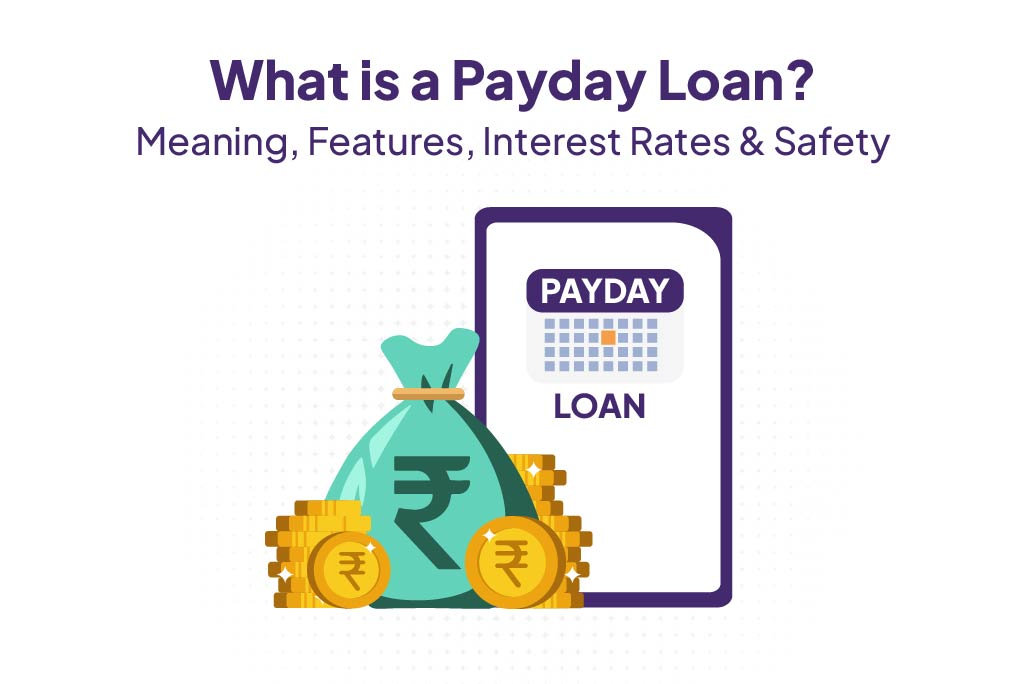
If you are facing an urgent financial need before payday, a payday loan may appear to be an easy option. However, understanding its meaning, features, interest rates, benefits, and potential risks is crucial. While these loans offer fast access to funds, they also come with higher interest rates and shorter repayment periods.
Payday loan meaning
A payday loan is one type of short-term loan, designed to help borrowers manage temporary cash flow gaps until their next source of income. A payday loan is generally repaid in a single payment or a few instalments, making it suitable for emergency expenses rather than long-term financial needs. You should always choose RBI-regulated lenders for greater transparency and consumer protection.
How does a payday loan work?
Most payday loans in India follow a simple application and repayment process.
Here’s how a payday loan typically works:
- Apply online: Fill out the loan application with basic personal, employment, and income details.
- Complete verification: Submit the required KYC documents. The lender assesses your eligibility and repayment capacity.
- Receive approval: If approved, you receive a loan offer with the amount, tenure, payday loan interest, fees, and other terms through a Key Fact Statement (KFS).
- Get the funds: After accepting the terms, the loan amount is transferred directly to your bank account.
- Repay on time: Repay the loan on the due date or as per the agreed installments. Timely repayment helps avoid additional charges and supports a healthy credit profile.
Key features of payday loans
Before applying, it is worth understanding what makes a payday loan different from other short-term credit options. Some of the key features of a payday loan include:
- Small loan amount: Most payday loans in India offer amounts ranging from ₹500 to ₹1,00,000, depending on the lender and your eligibility.
- Short repayment tenure: Repayment periods typically range from 2-4 weeks to 2 months, based on the lender’s policy.
- Unsecured loan: A payday loan generally does not require collateral or security.
- Minimal documentation: Many lenders ask only for basic KYC documents such as Aadhaar and PAN, along with income and bank account details for verification.
- Quick disbursal: Once approved, the loan amount is often credited to your bank account within a short time, subject to verification.
- Digital application: Most lenders let borrowers complete the entire process online, making it convenient for urgent funding needs.
- Higher borrowing cost: Compared to standard personal loans, interest rates for payday loans are generally higher.
Payday loan interest rates & charges in India
The interest rates for payday loans in India are generally higher than those of regular personal loans because of their short tenure and unsecured nature. Depending on the lender, payday loan interest typically ranges from 2% to 5% per month, with an effective annual percentage rate (APR) that may reach 36% to 48% or more.
Besides interest, lenders may also charge processing fees, late payment penalties, GST, or bounce charges. Before accepting a payday loan, carefully review the KFS to understand the total borrowing cost and avoid unexpected charges.
Benefits of payday loans
The benefits of payday loans can make them useful for short-term financial emergencies when borrowed responsibly.
- Helps manage urgent expenses: A payday loan can provide immediate funds for medical bills, utility payments, or unexpected repairs.
- Quick access to funds: Many lenders process applications rapidly, making these loans suitable for time-sensitive financial needs.
- No collateral required: Borrowers generally do not need to pledge assets, as payday loans are unsecured.
- Simple online process: Most payday loans in India can be applied for digitally, reducing paperwork and branch visits.
- Useful for temporary cash gaps: They help bridge the gap between paydays without disrupting regular financial commitments.
- Flexible usage: The loan amount can usually be used for any legitimate personal expense, with no end-use restrictions imposed by most lenders.
- Convenient repayment options: Many lenders offer automatic repayment through bank mandates or digital payment methods.
Are payday loans safe?
Yes, but only if you choose an RBI-regulated lender and fully understand the loan terms. However, it also comes with certain risks that every borrower should understand.
- A payday loan often carries higher interest and fees than a regular personal loan.
- Missing the due date can lead to late payment charges and additional interest.
- Delayed or missed repayments may negatively affect your credit history.
- Repeatedly relying on payday loans to repay existing debt can increase financial stress.
- The RBI has repeatedly cautioned borrowers against using unregulated digital lending apps that may engage in unfair recovery practices or lack transparent disclosures.
Payday loan vs personal loan
Both a payday loan and a personal loan provide quick access to funds, but they differ in terms of loan amount, repayment period, borrowing cost, and purpose. The table below highlights the key differences to help you choose the option that best suits your financial needs.
| Parameter | Payday Loan | Personal Loan |
| Purpose | Covers urgent, short-term expenses until the next salary | Suitable for planned or larger expenses such as medical treatment, travel, or home renovation |
| Loan amount | Usually ₹500 to ₹1,00,000 | Generally starts from around ₹10,000 and can go up to several lakhs, depending on the lender |
| Repayment tenure | Usually 2–4 weeks to 2 months | Typically, 12 months to 7 years |
| Interest rate | Higher, due to the short tenure and unsecured nature, usually 2-5% per month | Usually lower than payday loans, typically 10-24% per annum |
| Best suited for | Temporary cash shortages | Larger financial requirements and longer repayment needs |
If you are comparing both options, explore the FatakPay Personal Loan to understand how a regulated personal loan differs from a payday loan in terms of repayment flexibility, borrowing costs, and loan amount.
Better alternatives to payday loans
If a payday loan does not suit your needs, consider these alternatives before borrowing:
- Personal loan: Suitable for larger expenses and longer repayment periods, often with lower interest rates than payday loans.
- Loan against a fixed deposit (FD): Lets you borrow against your FD while keeping your investment intact.
- Credit card: Can help manage short-term expenses if you repay the outstanding balance within the interest-free period.
- Salary advance: Some employers provide salary advances, reducing the need for external borrowing.
- Borrowing from family or friends: This may be a cost-effective option if repayment terms are discussed and agreed upon in advance.
- Emergency savings: Using an emergency fund, if available, can help you avoid paying interest and additional borrowing costs.
Payday loan: Eligibility & how to apply safely
Before applying for a payday loan, check whether you meet the lender’s eligibility criteria and follow these steps to borrow safely:
- Confirm eligibility: Most lenders require applicants to be at least 18 years old, have a regular source of income, and maintain an active bank account. Eligibility may vary by lender. Some borrowers also compare payday loans with a no-credit-check loan, as both products may involve simplified eligibility assessments, although lenders still verify income, identity, and repayment capacity before approval.
- Choose a regulated lender: Apply only through RBI-regulated banks or NBFCs to reduce the risk of fraud.
- Keep documents ready: Aadhaar, PAN, income proof, and bank account details are commonly required.
- Review the KFS: Verify the payday loan interest, fees, repayment schedule, and penalty charges before accepting the offer.
- Borrow only what you need: Choose a loan amount you can comfortably repay on time to avoid unnecessary debt.
Conclusion
A payday loan can be useful for genuine short-term emergencies, but it should never become a long-term borrowing habit. Before applying, compare your options, borrow only what you can comfortably repay, and choose an RBI-regulated lender with transparent terms. If you need quick access to funds without the high cost often associated with payday loans, FatakPay offers a regulated instant personal loan with clear interest rates, transparent charges, and flexible repayment options, subject to eligibility.
FAQs
Q. What is a payday loan?
A payday loan is a small, short-term, unsecured loan designed to help borrowers meet urgent financial needs until their next salary or regular income. These loans typically offer quick approval and disbursal but often come with higher interest rates than regular personal loans. They should be used for genuine emergencies and borrowed only from RBI-regulated lenders.
Q. Are payday loans legal and safe in India?
Yes, payday loans are legal in India when offered by RBI-regulated banks or NBFCs or through authorised digital lending platforms. They can be safe if you choose a regulated lender, review the KFS, and understand all applicable interest rates, fees, and repayment terms before accepting the loan.
Q. What is the interest rate on a payday loan?
The interest rate on a payday loan varies by lender. In India, it typically ranges from 2% to 5% per month, although the actual rate depends on factors such as the lender’s policy, your eligibility, and repayment profile. Besides interest, lenders may also charge processing fees, GST, and late payment charges.
Q. What is the difference between a payday loan and a personal loan?
A payday loan is meant for short-term cash shortages and usually involves smaller loan amounts with higher interest rates. A personal loan is generally suitable for larger expenses, offers longer repayment tenures, and may have comparatively lower interest rates, depending on the lender and the borrower’s credit profile.
Q. How quickly is a payday loan disbursed?
Many lenders disburse payday loans within a few hours or on the same day after successful verification and approval. However, the actual disbursal time depends on the lender’s processing speed, document verification, and bank transfer timelines.
Q. What happens if I cannot repay a payday loan?
If you cannot repay a payday loan on time, the lender may charge late payment fees, additional interest, or penalty charges as specified in the loan agreement. Missed repayments can also affect your credit score. If you expect repayment difficulties, contact your lender as early as possible to discuss the available options.
Related Posts
| Personal Loans by City | ||||
|---|---|---|---|---|
| Personal Loan Bengaluru | Personal Loan Thane | Personal Loan Mumbai | Personal Loan Hyderabad | |
| Personal Loan Pune | Personal Loan Surat | Personal Loan Coimbatore | Personal Loan Delhi | |
| Personal Loans by Amount | ₹60,000 Personal Loan | ₹3 Lakh Personal Loan | ₹5 Lakh Personal Loan |
|---|
Explore our latest Personal Loan blogs for expert insights, financial tips, and guidance to help you make informed borrowing decisions.